comparison
NFL Hawaiian Shirts vs Jerseys: An Honest Comparison for NFL Fans
May
I compare products before I buy them. Always have. When I started looking at NFL fan apparel more carefully — what fans actually wear, when they wear it, and whether the gear they own covers the situations they actually find themselves in — the jersey versus Hawaiian shirt question kept coming up as one where most people were making a decision without thinking through all the variables. Both are legitimate pieces of NFL fan apparel. They don’t solve the same problem. The decision between them depends on what you’re actually trying to accomplish, and most fan apparel coverage treats them as competing options when they’re more often complementary ones. This is the comparison I wish existed before I bought my first few pieces of NFL fan gear.
The Core Comparison at a Glance
| Factor | NFL Jersey | NFL Hawaiian Shirt |
|---|---|---|
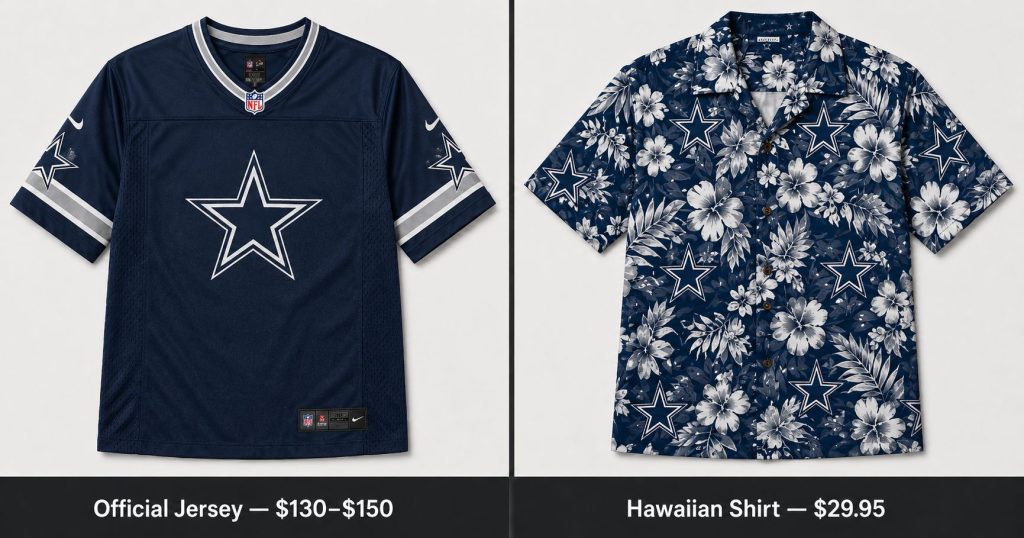
| Price (replica) | $130–$150 | $29.95 |
| Official licensing | Yes — NFL licensed | No — fan-designed |
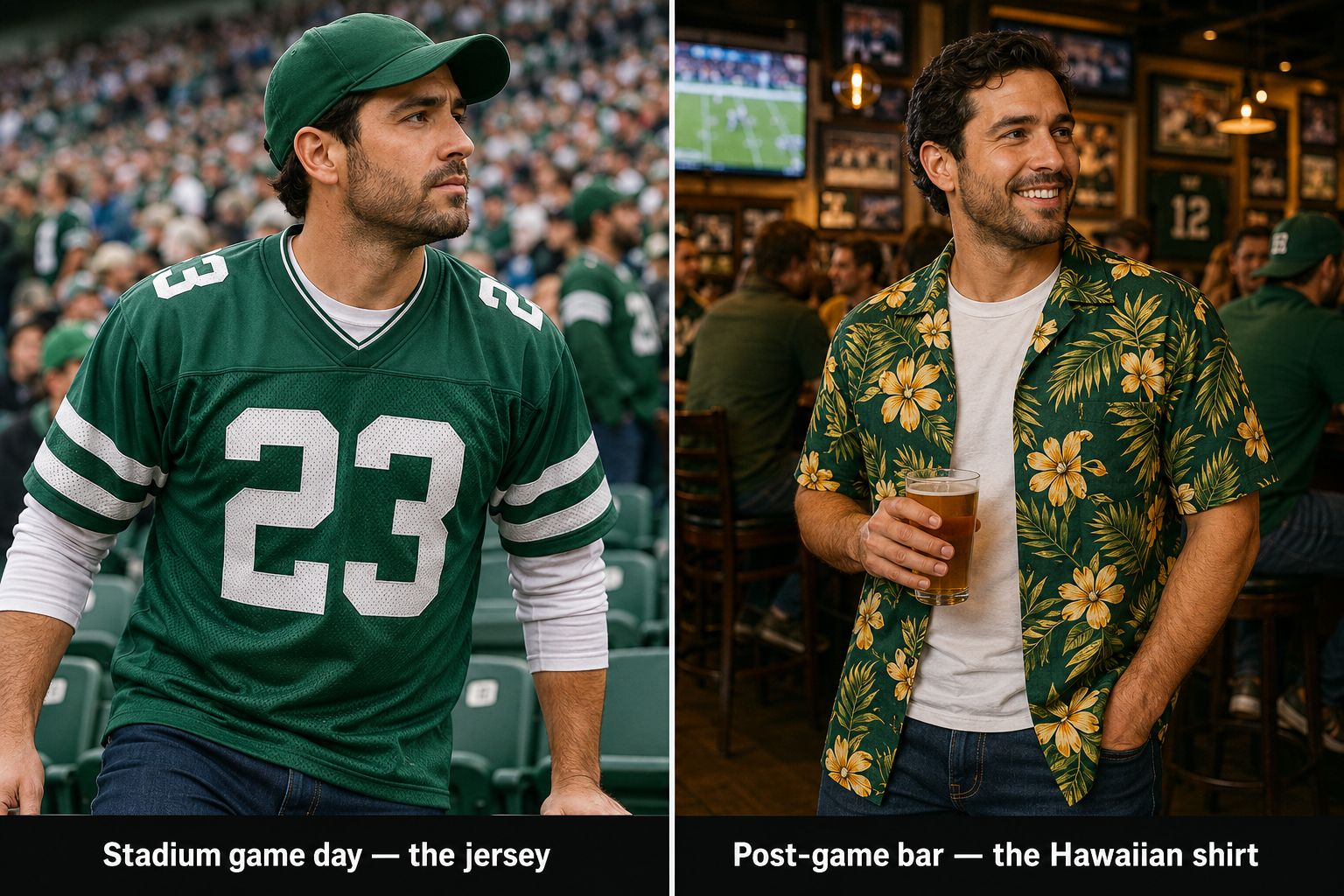
| Stadium game day | ✅ Ideal | ⚠️ Works, not optimal |
| Post-game bar / restaurant | ⚠️ Possible, overdressed | ✅ Ideal |
| Office / casual Friday | ❌ Too casual | ✅ Works buttoned |
| Tailgate (warm weather) | ✅ Standard | ✅ Breathes better |
| Cold weather layering | ✅ Worn over base layer | ✅ Worn under jacket |
| Gift versatility | ⚠️ Risky — player/era preference | ✅ Safer — no player guess needed |
| Personalization available | Yes — player names only | Yes — any name/number |
| Everyday wear range | Low — game day only | High — multiple contexts |
| Collector / resale value | Yes — especially signed or retired | No |
Price: The Gap Is Larger Than Most People Expect
A replica NFL jersey from official retail runs $130–$150. An authentic (stitched) jersey runs $300–$350. An NFL Hawaiian shirt runs $29.95. That’s not a marginal difference — it’s a 4-to-1 ratio at the replica level. Whether that gap matters depends entirely on what you’re buying the item for.
If you’re buying a Jalen Hurts #1 Eagles jersey because you want official licensed fan gear with the player’s actual name and number for stadium attendance, the $130–$150 is what it costs and there’s no real substitute. The jersey is the right product for that use case and the price reflects what it is. If you’re buying NFL fan apparel that works at a watch party, a casual office environment, or as a gift for someone whose player preferences you don’t know well, spending $130 on a jersey when a $29.95 Hawaiian shirt covers the use case better is an overpay for the wrong product.
The price comparison also matters differently for fans who want to represent multiple teams or multiple eras of the same team. Owning jerseys for the Favre era and the Rodgers era and the current Love era of the Packers means $390–$450 at minimum. Owning Hawaiian shirts across all three in green and gold costs under $90. For fans who care about representing a full franchise history rather than just the current roster, the economics shift significantly in favor of the Hawaiian shirt format.
Official Licensing: Does It Matter?
NFL jerseys are officially licensed products — they carry the NFL shield, the team marks, the player name and number rights, and they’re produced under contracts with the league and teams. NFL Hawaiian shirts from fan-designed manufacturers are not officially licensed — they use team colors and fan-created designs rather than official logos and player names under license.
Whether this matters depends on the buyer. For fans who want the official product specifically — the authentic Nike jersey with the actual team marks, the one that matches what players wear on the field — only the jersey delivers that. For fans who want fan apparel that reads as clearly their team’s colors and communicates fan identity in everyday contexts, the licensing distinction is less important than whether the color and design are accurate. A green and gold all-over print Packers Hawaiian shirt that gets the Packers green right communicates Packers fan identity as effectively as an official item in most non-stadium social contexts.
The licensing distinction does matter for one specific use case: collector value. A signed official jersey has provenance and potential resale value; a signed Hawaiian shirt does not. For fans buying items as collectibles or long-term investments, the jersey’s official status is meaningful. For fans buying wearable fan apparel, the distinction matters less.
Where Each One Wins: Context-by-Context Breakdown
The jersey wins for stadium attendance during high-stakes games. At Lambeau Field in January during a playoff game, at Lincoln Financial Field when the Eagles are hosting a divisional rival, at Arrowhead Stadium when Chiefs Kingdom is at full volume — the jersey is the right piece of gear for the environment. It signals complete game-day commitment in a way that a Hawaiian shirt, however good it looks in other contexts, doesn’t quite match when 70,000 people are wearing the same colors and the crowd noise is at that level. The jersey is stadium-native gear, and at those moments it’s the right call.
The Hawaiian shirt wins for everything that happens around the game but not inside the stadium. A South Philly bar before and after a Packers road game against the Eagles. A watch party in a living room or a sports bar for any of the 17 regular season games that don’t involve stadium attendance. A tailgate in September when the temperature is 75°F and a jersey over a base layer is genuinely uncomfortable. A casual Friday at the office during the season. A post-game bar where the crowd has transitioned from game-day intensity to a social evening and full stadium kit reads as slightly overdressed. The Hawaiian shirt covers this arc more naturally than the jersey does.
In cold-weather contexts — which matter specifically for teams like the Green Bay Packers, the Buffalo Bills, the New England Patriots, the Chicago Bears — both products have a role but in different ways. The jersey is typically worn as an outer layer over a fitted thermal or long-sleeve base, the mesh fabric open enough to show the base layer at the collar and sleeves, then a heavy jacket over everything for the walk from the parking lot. The Hawaiian shirt works in cold-weather contexts as a middle layer — buttoned fully under a Packers hoodie or insulated jacket, the green and gold floral pattern visible at the open collar when the jacket is zipped, then fully visible when the outer layers come off inside a heated stadium concourse or post-game bar. Both can be part of a cold-weather game-day outfit; they just occupy different positions in the layering system.
Wearability: How Often Will You Actually Wear It?
This is the question most fan apparel purchases don’t fully consider. A jersey worn at 8 home games per season, plus watch parties and occasional casual wear, gets perhaps 15–20 wear cycles per year. A Hawaiian shirt that works at the office on casual Fridays, at bars during the week, at social occasions where the jersey would be overdressed, at tailgates, and as an inner layer in cold weather can accumulate significantly more wear cycles across a longer annual window.
The practical implication is that the cost-per-wear math often favors the Hawaiian shirt despite the lower sticker price, because it gets worn more frequently in more contexts. A $150 jersey worn 15 times per year costs $10 per wear. A $29.95 Hawaiian shirt worn 40 times per year costs under $0.75 per wear. Neither calculation is the point — the point is that the Hawaiian shirt’s broader use case means it integrates into a wardrobe in a way the jersey doesn’t, which affects how much value the purchase actually delivers.
This calculus changes if the jersey is a collector’s item or has specific sentimental value attached to a player or moment. A jersey worn at a Super Bowl watch party the year your team won, or purchased at a stadium after a historic game, or signed by a player you admire — these accrue a different kind of value that cost-per-wear doesn’t capture. The Hawaiian shirt doesn’t compete with the jersey as a collector’s item or a commemorative object. It competes with it as a wearable piece of everyday fan apparel, and that’s the comparison that matters for most purchase decisions.
Gift-Giving: Where the Hawaiian Shirt Has a Clear Advantage
Buying a jersey as a gift for an NFL fan carries more risk than most gift buyers anticipate. Player preference, era allegiance, home versus away colorway, stitched versus printed construction, and fit preference — serious NFL fans usually have opinions on all of these, and guessing wrong means buying a duplicate or something the recipient actively doesn’t want. A Packers fan whose identity is anchored in the Brett Favre era may not want a Jordan Love jersey. An Eagles fan who followed the Nick Foles Super Bowl LII run may not want a Jalen Hurts. A Cowboys fan with specific feelings about the Troy Aikman dynasty era may not want the current roster. These aren’t edge cases — for dedicated fans, era preference is a real variable that makes jersey gifting genuinely risky without specific knowledge of the recipient.
There’s a deeper framing here that most comparisons miss. A jersey ties you to a specific player and a specific era. A Rodgers #12 jersey is a declaration about a chapter of the franchise — the four MVP seasons, Super Bowl XLV, the complicated departure. When Rodgers left for the Jets, that jersey didn’t change, but what it communicated did. An Eagles Foles #9 jersey is specifically about Super Bowl LII. A Cowboys Aikman #8 is specifically about the dynasty years. These are meaningful identities, but they’re narrow ones — tied to a player who may no longer be with the team, an era that may have ended, a chapter the franchise has moved past.
A green and gold Packers Hawaiian shirt, a midnight green Eagles Hawaiian shirt, a navy and silver Cowboys Hawaiian shirt — these tie the wearer to the franchise itself rather than to a single chapter of it. The all-over print format represents the colors that have been there through every era, every quarterback, every coaching staff, every Super Bowl run and every disappointing season. For fans who have followed a team across multiple generations of players and feel loyalty to the organization rather than to any single roster, the Hawaiian shirt format carries a different kind of identity signal than the jersey does — broader, more durable, less dependent on whether the player on the back is still relevant.
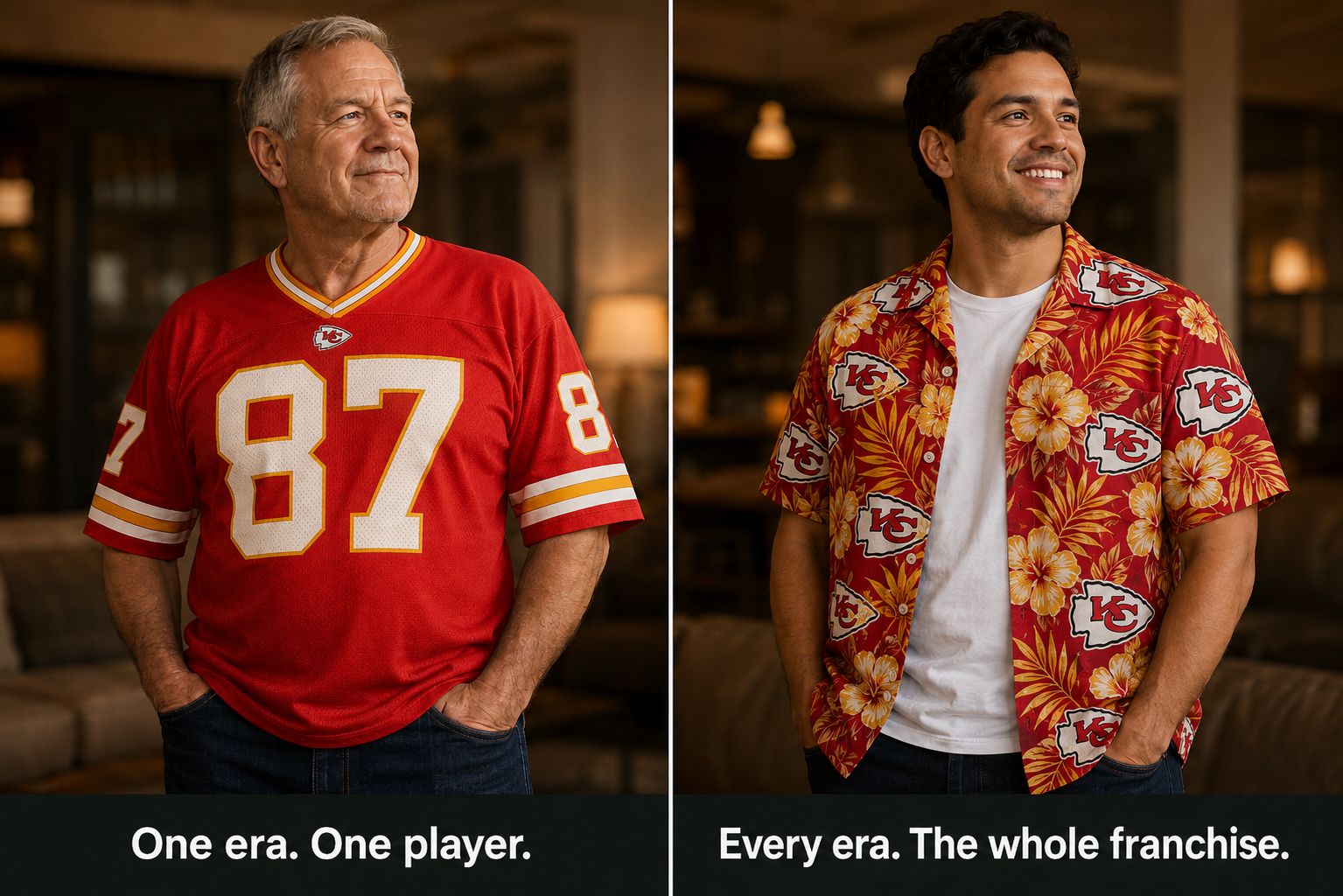
For fans who already own jerseys and standard gear, a custom name and number Hawaiian shirt offers something that official retail doesn’t: personalized fan apparel in team colors with any name or number integrated into the design. This is specifically valuable for fans with era-specific loyalties — Rodgers #12 on a Packers Hawaiian shirt, Dawkins #20 on an Eagles one, Aikman #8 on a Cowboys one — in a format the official jersey market has moved away from. For gift guides covering specific teams, the Packers fan gift guide, the Eagles fan gift guide, and the Chiefs fan gift guide cover team-specific gifting situations in detail.
Fan Identity Signaling: Different Registers, Not Better or Worse
The jersey and the Hawaiian shirt signal fan identity differently, and understanding the difference helps clarify which one is right for which situation rather than treating one as objectively superior.
A jersey signals game-day commitment. It’s the uniform of a fan who is fully in game-day mode — the same thing players wear, in the same team colors, with a specific player’s name and number as a declaration of allegiance. In the right context — stadium attendance, high-stakes viewing parties with committed fans, road game situations where visibility matters — the jersey’s intensity of signaling is exactly right. In a context where that intensity is slightly out of register — a casual bar on a Tuesday, a work function during the season, a family gathering where not everyone follows football — the jersey can overshoot.
A Hawaiian shirt signals fan identity with lower intensity but broader context range. It says “I follow this team” without saying “I am currently in full game-day mode.” That lower register is what makes it work in everyday contexts where the jersey doesn’t. It’s the difference between wearing a suit and wearing a blazer — both are appropriate, but for different occasions, and wearing the wrong one for the context reads as a mismatch even when both are technically correct fan apparel.
The Honest Verdict: Buy Both, Use Each in Its Right Context
After comparing these two products across price, use case, wearability, gift value, and fan identity signaling, the conclusion isn’t that one beats the other. It’s that they’re not actually competing for the same use cases, and most serious NFL fans end up owning both for exactly this reason.
Buy the jersey first if your primary NFL fan apparel use case is stadium attendance and you want official licensed gear that matches the game-day environment. The $130–$150 investment is appropriate for a product that delivers official licensing, player-specific identity, and the right signal for the right context.
Buy the Hawaiian shirt if you want NFL fan apparel that covers the other 340-plus days of the year when you’re not at a game but you still want to carry your team’s identity — the watch parties, the office casual Fridays, the post-game bars, the summer cookouts, the tailgate warm-ups. At $29.95, it fills a gap the jersey doesn’t cover at a price point that doesn’t require the same deliberation.
Own both if you’re a serious NFL fan who attends games and also wants to represent your team in everyday contexts. The total investment is under $200 for both products, which covers the complete range of NFL fan apparel situations most fans actually encounter across a full season.
Find the NFL Hawaiian shirt that works for your team identity outside game day →
Frequently Asked Questions
Are NFL Hawaiian shirts better than jerseys?
Neither is objectively better — they solve different problems. Jerseys are better for stadium game-day attendance, official licensed gear, and high-stakes game contexts where full fan identity signaling fits the environment. Hawaiian shirts are better for post-game bars, casual office wear, everyday fan identity, warm-weather tailgates, and as gifts when the recipient’s player preferences aren’t known. Most serious NFL fans own both for this reason.
Can you wear an NFL Hawaiian shirt to a game?
Yes — it works at games, particularly in warm-weather contexts and for fans who want fan apparel that transitions naturally from the tailgate through the post-game bar without a change. For high-stakes playoff games and situations where full game-day commitment is the right register — January at Lambeau, a divisional championship game — the jersey is the more appropriate choice. For September and October regular season games, the Hawaiian shirt is a legitimate game-day option that stands out in a crowd of jersey replicas.
Why are NFL Hawaiian shirts so much cheaper than jerseys?
NFL jerseys are officially licensed products produced under NFL and player association licensing agreements — the price includes those licensing costs plus the official team marks and player name rights. NFL Hawaiian shirts are fan-designed and not officially licensed, which removes the licensing cost from the price. The $29.95 fan-designed Hawaiian shirt and the $130–$150 official jersey are genuinely different products in terms of licensing, and the price difference reflects that rather than a difference in fabric or print quality.
Are NFL Hawaiian shirts officially licensed?
No — fan-designed NFL Hawaiian shirts are not officially licensed by the NFL, the NFLPA, or individual teams. They use team colors and fan-created designs rather than official licensed marks. Official NFL jerseys are licensed products. For fans who specifically want officially licensed fan apparel, jerseys are the appropriate product. For fans who want team-colored fan apparel for everyday wear contexts at a lower price point, fan-designed Hawaiian shirts fill a different gap in the market.
What is the best NFL Hawaiian shirt for game day?
For game day specifically, the flagship all-over print design in your team’s primary colors is the strongest option — it distributes team colors across the full garment in a way that reads clearly as fan identity from a distance. The specific design that works best varies by team: for the Packers, green and gold all-over print; for the Eagles, midnight green; for the Cowboys, navy and silver; for the Chiefs, red and gold. For team-specific recommendations, the individual team buying guides cover which designs hold up best on color accuracy and design coherence for each franchise.
Is an NFL Hawaiian shirt a good gift for someone who already owns a jersey?
Yes — specifically because it fills a gap the jersey doesn’t cover. A fan who owns a Jalen Hurts #1 Eagles jersey already has game-day stadium gear. A midnight green Eagles Hawaiian shirt gives them everyday fan apparel for the office, watch parties, and social contexts where the jersey is slightly overdressed. For fans who have been accumulating jerseys across multiple eras of a franchise, the custom name and number Hawaiian shirt option — which can be personalized with any player name and number, including retired players that official retail no longer carries — is the one category they likely don’t already own.
Written by Don Houbler · NFLHawaiianShirt.com Comparison
See also: Best NFL Hawaiian Shirts Ranked by Team · What to Wear to an NFL Game · Best Green Bay Packers Hawaiian Shirts · Best Philadelphia Eagles Hawaiian Shirts