
style outfit
What to Wear to an NFL Game: 12 Outfit Decisions That Actually Work, Zone by Zone
May
An NFL game day runs 6 to 8 hours across four distinct zones: parking lot, entry lines and concourse, seating, and the post-game exit into a bar or restaurant. Each zone has different physical demands, different temperature exposure, and a different social context. The question of what to wear to an NFL game isn’t really about fashion — it’s about one outfit solving all four zones without failing in any of them. Knowing what to wear to an NFL game starts with understanding those four zones — because one outfit needs to solve all of them.
Most game day outfit guides stop at “jersey and jeans.” That’s a valid answer for one zone. This one maps 12 specific situations to the outfit logic that actually works for each — including what goes wrong when you make the wrong call.
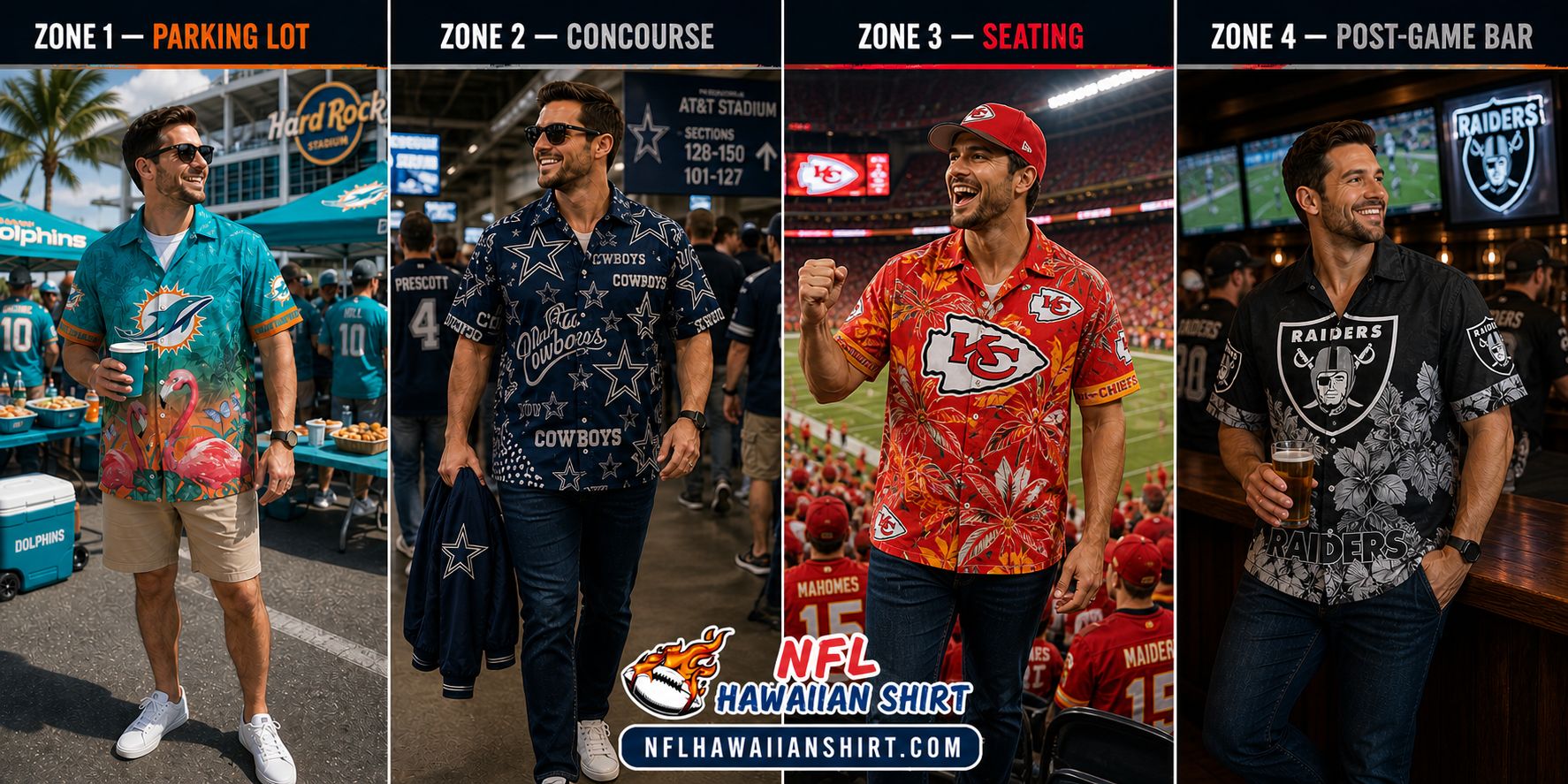
The 4 Physical Zones of Game Day
Before the outfit decisions, the zones matter. They define what you’re actually dressing for.
Zone 1 is the parking lot and tailgate. This is where you’re most physically active and most exposed to the weather. You’re standing on asphalt, moving between groups, carrying things, and spending the most time in outdoor temperature extremes. It’s also where your outfit is most visible — the social signaling function of fan gear operates at maximum range here.
Zone 2 is entry and concourse movement. You’re moving shoulder-to-shoulder through gates and concession lines. You stop and start repeatedly. If you have layers, you’re now managing them with your hands full. Anything that needs adjustment becomes a problem here.
Zone 3 is seating. You stand during scoring plays and sit during lulls. You generate heat during active moments and lose it during static ones — which means the temperature you feel in Q1 is different from what you feel in Q3 when you stop moving. Wind behaves differently when you’re static. The bowl shape of most NFL stadiums channels it directly into the seating section.
Zone 4 is exit and post-game. High-density crowd movement through exits, then transition to a bar or restaurant. What you’re wearing now has to function as social gear, not just stadium gear. If you planned a post-game bar stop, your outfit needs to make that transition without requiring you to change.
An outfit that solves Zone 1 but fails Zone 4 — or handles Zone 3 cold but not Zone 1 heat — isn’t a game day outfit. It’s a partial solution.
12 NFL Game Day Outfit Decisions
1. September afternoon game, outdoor stadium, hot climate
The situation: you’re on asphalt at a tailgate with the sun overhead, then in an open-air stadium for three hours. Hard Rock Stadium in Miami, SoFi in Los Angeles, State Farm in Arizona — afternoon September games at these venues involve radiant heat from concrete and metal seating in addition to air temperature. You’re not just warm; you’re hot from multiple directions.
The decision: an all-over print NFL Hawaiian shirt in your team’s colors, worn open over a team tee, with shorts and clean sneakers. The woven polyester in a Hawaiian shirt moves air differently than a cotton jersey — cotton traps moisture against skin once you start sweating, which makes the heat feel worse through the afternoon. The open-layer format gives you a second option as temperature shifts between tailgate and stadium. The consequence of arriving in a heavy jersey at a Miami September afternoon game is that you’re miserable by halftime and nothing you can do changes that without leaving.
Browse the Miami Dolphins Hawaiian shirt collection for hot-weather game day options →
2. First NFL game, unfamiliar stadium
The situation: you don’t know the seating section temperature, the entry layout, whether there’s wind exposure in your specific section, or whether you’ll end up somewhere after the game. Every variable is unknown.
The decision: team tee in your team’s primary color, dark jeans, clean sneakers. This is the zero-risk baseline — it reads correctly as fan identity, it’s comfortable across all four zones, and it doesn’t require any decisions during the game. The consequence of over-engineering your first game day outfit is that you spend mental energy managing it instead of watching the game. Save the experimentation for when you know the stadium.
3. Tailgate host, 6-hour outdoor session
The situation: you’re stationary and moving, hosting and walking, visible to the entire tailgate section for the duration. You’re managing food, drinks, and people. You’ll be moving from the parking lot into the stadium without a transition point.
The decision: all-over print Hawaiian shirt worn open over a team tee. The format reads as fan identity from 20 feet, which matters when you’re the fixed point that people are navigating toward. A jersey reads clearly at 5 feet; an all-over print reads clearly at 20. You’re also layered for the temperature arc from tailgate to stadium and back, and the polyester construction handles spills without requiring immediate attention. The consequence of wearing a single heavy layer for a 6-hour tailgate is that you’re either too hot during active periods or underdressed when temperature drops after the game.
Find the right Hawaiian shirt for your team’s tailgate →
4. Rivalry game, home section
The situation: crowd density is at its highest, tribal identity signals carry real social weight, and the energy in the seating section is calibrated to the game’s stakes. At Arrowhead during a Chiefs-Raiders AFC West game, Chiefs Kingdom is operating at full signal intensity from the parking lot through the final whistle.
The decision: bold team colors with clear visual identity — all-over print in your team’s primary palette, or a full jersey if you prefer. Subtle fan gear in a high-signal rivalry environment reads as uncertain allegiance, which creates a different kind of crowd friction than the alternative. The social mechanics of a rivalry game reward clear, visible team identification. The consequence of wearing neutral or muted team gear to Arrowhead on a rivalry Sunday is that you’re socially invisible in a crowd that’s specifically organized around visibility.
5. October mid-season game, variable weather
The situation: 60°F at kickoff and 46°F by the final whistle, with wind picking up in Q3 when you’ve been static for two quarters. You generated heat during the first half. In the third quarter, that sweat cools against your skin and the temperature drop hits harder than the thermometer suggests.
The decision: a long-sleeve base layer, an all-over print Hawaiian shirt worn open, and a team jacket in your bag. You strip to the Hawaiian shirt during the active tailgate, keep the base layer for warmth in transit, and add the jacket when you stop moving in your seat. Three independent adjustable layers beat one heavy coat because a coat is binary — on or off — while layers let you calibrate to each zone. The consequence of arriving in a single heavy layer is that you’re too hot at the tailgate and not warm enough in your seat by Q3.
6. Game day that ends at a bar
The situation: you’re going directly from the stadium to a bar or restaurant after the game without stopping to change. The exit crowd is high-density and moving slowly. You have 20 minutes between stadium exit and bar arrival.
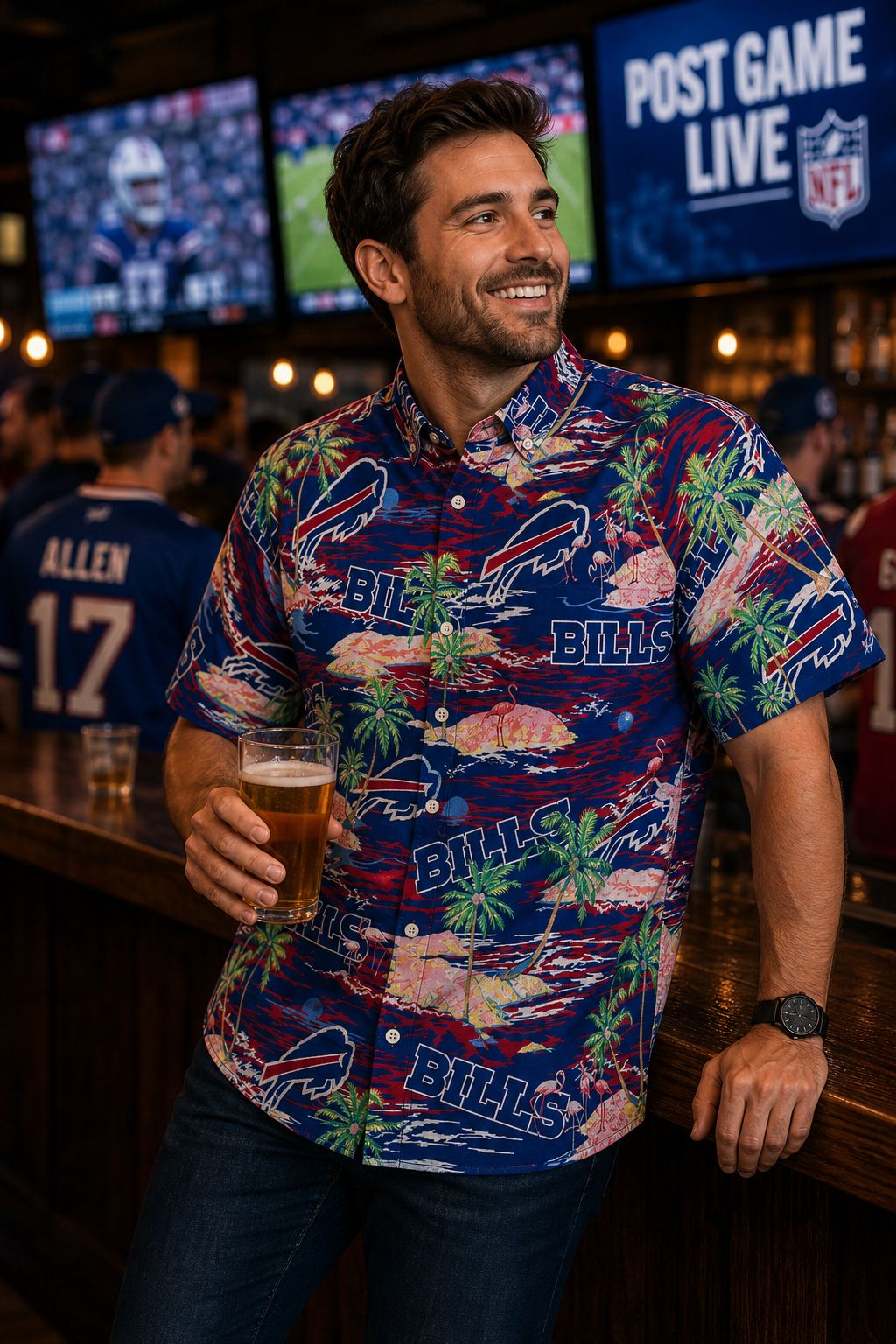
The decision: Hawaiian shirt buttoned, dark chinos or dark jeans, clean shoes that work for both stadium ramps and a bar environment. Jersey at a bar signals that you haven’t transitioned out of game mode — it’s a social register mismatch that most people intuitively read even if they don’t articulate it. A buttoned Hawaiian shirt in team colors carries the same fan identity signal in a different social context. You didn’t plan two outfits. You wore one that solves both zones. The consequence of wearing only stadium-specific gear to a post-game social setting is a subtle friction that’s entirely avoidable with a single outfit decision made before you left the house.
7. Away game travel, flying in
The situation: carry-on only, arriving in a stadium where you’re in the away section, and you need gear that packs without creasing and reads as clear fan identity in a crowd that’s actively hostile to your team.
The decision: an all-over print Hawaiian shirt. It folds flat without creasing in the way a jersey does, it reads as deliberate fan gear rather than tourist apparel, and it layers for the transition from plane to stadium to wherever you end up after the game. In an away section, you’re already making a statement — your outfit should make it clearly. The consequence of showing up in a creased jersey after a 3-hour flight is that you’ve already started the day behind on the only thing that matters in an away section, which is looking like you meant to be there.
8. Custom name or personalized shirt debut
The situation: you’re wearing your own name, a retired player’s number, or a design that doesn’t exist in official retail. The shirt is the statement. Everything else is context.
The decision: the simplest possible supporting outfit — dark jeans, clean white or team-color tee underneath if you’re wearing it open, clean sneakers. Nothing competes with the shirt. The purpose of a custom all-over print is that it’s a specific piece of fan identity that nobody else has in the stadium. Supporting it with a complex outfit dilutes that signal. The consequence of pairing a statement shirt with a complex outfit is that neither element lands clearly.
Custom name and number options available in most team collections →
9. Club level or premium seating
The situation: climate-controlled or semi-controlled environment, less crowded than general seating, bar service at or near your row. The physical demands of the four zones are reduced — entry is easier, seating is more comfortable, temperature management is less critical.
The decision: Hawaiian shirt worn buttoned, unstructured blazer over it, dark chinos. The weather variable is gone, which means the decision shifts entirely to social register. A jersey in club level seating signals that you didn’t calibrate your outfit to where you were sitting — not wrong, but noticeable. A buttoned Hawaiian shirt with a blazer reads as intentional fan gear in a more polished context. The consequence of wearing only stadium-grade gear to premium seating is a register mismatch that the other people in your row will notice even if they don’t say anything.
10. November cold, open-air stadium
The situation: 38°F air temperature with wind channeling through the stadium bowl. You stand during scoring plays and generate heat — then sit during lulls and lose it. The temperature you experience in your seat is colder than the forecast because you’re static in a wind channel. Arrowhead Stadium in Kansas City and Acrisure Stadium in Pittsburgh are two of the coldest environments in the AFC when January wind picks up — both funnel air directly into the seating sections in ways the parking lot forecast doesn’t capture.
The decision: thermal base layer, all-over print Hawaiian shirt as a mid-layer, heavy team jacket as the outer layer, beanie, gloves. The three-layer system works because each layer is independently adjustable. The base layer handles static cold. The Hawaiian shirt adds a mid-layer that can come off at the tailgate when you’re active. The jacket handles the wind in the seating section. The consequence of arriving in a single heavy coat is that you’re too warm during active tailgate movement and the coat doesn’t insulate well enough when you’re sitting still in wind because there’s no base layer trapping body heat.
11. January playoff game, Lambeau or Highmark
The situation: 15°F wind chill, 3 hours of primarily static seating exposure. This is the most demanding thermal environment in professional football. Green Bay in January is not a weather variable — it’s a different category of game day entirely.
The decision: heavyweight thermal base layer, Hawaiian shirt as a mid-layer for additional insulation, heavyweight team jacket rated for below-freezing temperatures, insulated beanie, gloves. The Hawaiian shirt’s function here is entirely thermal — it’s a mid-layer, not a statement piece. Woven polyester traps air between the base layer and the outer jacket, adding insulation without significant weight. The visibility of the shirt is irrelevant at 15°F. The consequence of arriving at Lambeau in January without a proper layering system — treating it like a November game — is hypothermia risk, which is not a dramatic claim, it’s what happens when you sit still in wind chill below 20°F for three hours.
12. Group attendance, coordinated look
The situation: four to eight people going together, with different sizes, preferences, and relationships to fan gear formality. You want visual cohesion — to read as a group — without requiring everyone to wear identical outfits.
The decision: same team, different Hawaiian shirt designs. Four people in different all-over print Chiefs designs in red and gold read as an organized group with a shared identity. Four people in identical jerseys read as a uniform. The difference is that a coordinated group using different designs within the same color palette signals intentional fan identity, while matching jerseys signal that everyone was handed the same thing. The consequence of trying to force identical outfits across a group is that someone always doesn’t fit the format — different body types, different comfort levels, different budgets — and the coordination breaks down before game day.
How the Stadium Changes the Equation
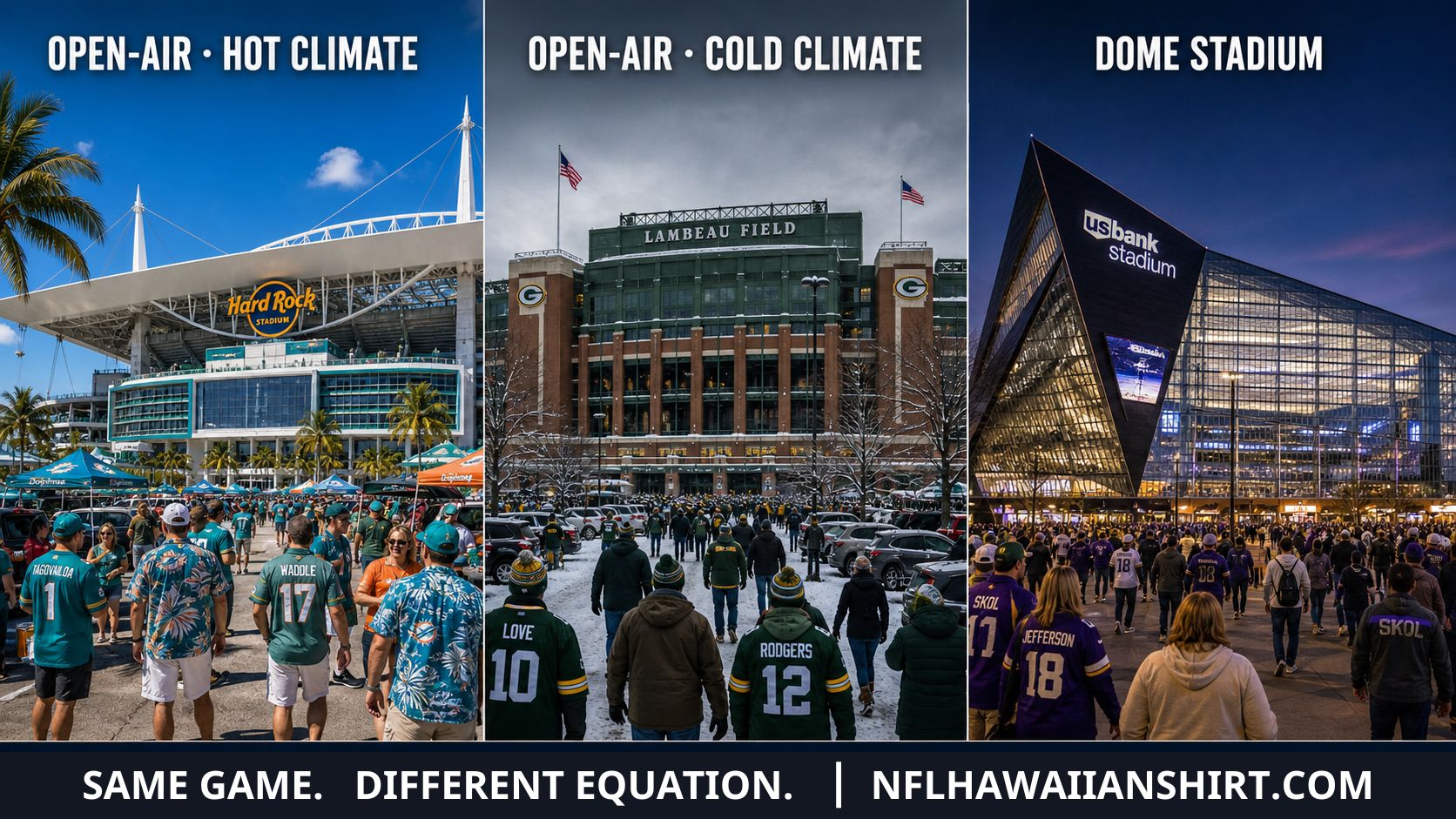
The four zones apply everywhere, but the specific demands vary by stadium type in ways that matter for outfit decisions.
Open-air stadiums in hot climates — Hard Rock in Miami, SoFi in Los Angeles, State Farm in Arizona — add radiant heat to air temperature. Your seat is a metal surface that’s been absorbing sun exposure. The concourse is asphalt and concrete. You’re not just dealing with air temperature; you’re dealing with heat radiating from every surface around you. Ventilation matters more than weight. An outfit that moves air solves this context; a single heavy layer doesn’t.
Open-air stadiums in cold climates — Lambeau Field in Green Bay, Highmark Stadium in Buffalo, Soldier Field in Chicago, MetLife in New Jersey — funnel wind through the bowl structure into seating sections. The forecast temperature is not what you experience in your seat. Wind chill in the seating area runs consistently colder than conditions outside the stadium. You’re dressing for the static exposure of sitting in that wind channel, not for the active exposure of walking to the stadium. Layering for stillness, not movement, is the correct frame.
Dome stadiums — U.S. Bank Stadium in Minneapolis, Mercedes-Benz Stadium in Atlanta, Caesars Superdome in New Orleans — eliminate weather as a variable entirely. Climate control means you’re dressing for the social context of the game and the post-game, not for temperature management. The outfit decision shifts entirely to what works across Zone 3 seating comfort and Zone 4 post-game transition.
For venue-specific breakdowns, the Arrowhead Stadium outfit guide and the AT&T Stadium outfit guide cover each venue’s specific demands — including the indoor-outdoor split at Jerry World and Arrowhead’s temperature arc from September tailgate to January playoff.
Outfit Choices with Predictable Negative Consequences
There are a few categories of game day outfit decisions that have consistent, predictable outcomes that are worth knowing before you make them.
Dress shoes on stadium floors produce a specific outcome. Concourse floors accumulate spilled beer from the first quarter onward. Stadium ramps are wet concrete in any weather event. Leather soles on wet concrete with foot traffic from 50,000 people moving in the same direction have a documented failure mode. The consequence isn’t hypothetical — it’s mechanical.
Anything that requires dry cleaning creates a liability in a stadium environment. Beer spills at NFL games happen in celebration and in accident. In a packed seating row, you are not the only variable. An outfit that can’t go through a washing machine is a calculated risk against a near-certain outcome. Woven polyester does not share this liability.
Opposing team colors in a home section create social mechanics that are separate from safety. You become the focal point of crowd energy that has nowhere else to go during a tight game. This is not a concern at every stadium — some crowds are more relaxed about it than others — but at Arrowhead during a rivalry game, or at Lincoln Financial Field during any game, the crowd response to opposing colors is consistent and predictable. Wearing your own team’s colors doesn’t require a jersey. It requires being in the right color range.
Neutral or plain clothing in a high-signal crowd creates a different kind of friction. Walking through the Arrowhead parking lot in no particular team color when Chiefs Kingdom is operating at full intensity creates a social visibility problem that’s entirely optional. Team color in any format — tee, Hawaiian shirt, hoodie — solves it.
Frequently Asked Questions
Can you wear a Hawaiian shirt to an NFL game?
Yes. The all-over print format reads as team identity from a distance, layers cleanly for temperature changes across game day zones, and transitions to post-game social settings without requiring an outfit change. It solves the Zone 1 tailgate visibility problem, the Zone 3 temperature management problem, and the Zone 4 social context transition — which is a better zone coverage record than a jersey, which solves Zone 1 and Zone 3 but creates friction in Zone 4.
What do most NFL fans wear to games?
The jersey is the plurality choice — it’s the most recognized fan identity signal, and it works well for Zones 1 through 3. Team colors in any format — Hawaiian shirt, hoodie, team tee — communicate the same core identity. The jersey isn’t a requirement; team colors are. The difference matters when you’re planning for Zone 4 or for a weather situation that a jersey doesn’t handle well.
What should I wear to an NFL tailgate versus inside the stadium?
The tailgate optimizes for Zone 1: active movement, full weather exposure, maximum visibility. The stadium optimizes for Zone 3: static seating, wind exposure, temperature arc across the game. An outfit that solves the tailgate — layerable, breathable, visible — usually solves the stadium as well. The reverse isn’t always true; an outfit optimized for static seated warmth can be uncomfortable during active tailgate movement.
What to wear to an NFL night game?
Temperature drops after sunset in open-air stadiums, and the drop is amplified by the static seating exposure of Zone 3. A September night game feels like October conditions. An October night game feels like November. Add one layer to whatever you’d plan for the equivalent daytime temperature. The layering framework — base layer, mid-layer, outer layer — applies with one additional unit of warmth relative to the forecast.
What to wear to an NFL game as a woman?
The same zone mechanics apply regardless of how you’re dressing. Team colors, comfortable footwear for Zone 2 concourse movement and Zone 1 tailgate terrain, and layers for Zone 3 temperature management. Women’s cuts are available in most team Hawaiian shirt collections — the all-over print format works identically to the men’s cut for zone coverage and identity signaling purposes.
The Outfit That Works for All Four Zones
The game day outfit question resolves to one test: does it handle Zone 1 visibility and Zone 1 heat or cold, Zone 2 mobility, Zone 3 temperature arc, and Zone 4 social transition? Most individual items solve one or two zones. Layered systems — a Hawaiian shirt as a mid-layer or statement piece depending on weather, worn over a base and under an outer layer when needed — solve all four.
Find your team’s collection and the all-over print format that works for your game day context. The best NFL Hawaiian shirts buying guide covers every team’s collection if you’re deciding between options.
Shop NFL Hawaiian shirts by team →
Published by Cliff Straham · NFLHawaiianShirt.com Style & Outfit