
fandom culture
Green Bay Packers Fan Culture: What Makes the Cheeseheads Different From Every Other Fanbase in Professional Football
May
There’s a detail about the Green Bay Packers that most NFL fans know abstractly but haven’t fully processed: the team is owned by the community. Not by a billionaire from out of state. Not by a private equity consortium. Not by an heir to a family fortune who moved the franchise from one market to a better television deal. The Green Bay Packers are a publicly owned nonprofit corporation with over 500,000 shareholders — most of them ordinary Wisconsin residents and fans who bought stock not as an investment (the shares pay no dividends and can’t be sold on the open market) but as a statement of belonging. That ownership structure is the foundation of everything else about Packers fan culture. Every tradition, every piece of fan identity, every reason the waiting list for season tickets stretches across generations — all of it flows from the fact that this team is, in a literal legal sense, the people’s team. I’ve studied fanbase cultures across every division in professional football. No other situation resembles this one.
The Community Ownership Story
The Green Bay Packers have been publicly owned since 1923, when the team faced financial collapse and the community of Green Bay — a city of roughly 30,000 people at the time — raised money through a public stock sale to keep the franchise alive. The model was unusual then and remains unique in American professional sports today. The NFL’s current bylaws actually prohibit any new team from replicating the Green Bay ownership structure — meaning the Packers will remain the only community-owned team in the league indefinitely.
The practical consequences of this ownership structure are significant for fan culture. The team cannot be relocated. There is no owner who can decide to move the franchise to a larger market for a better stadium deal — a threat that has hung over Cleveland, Oakland, San Diego, St. Louis, and other NFL cities in recent decades. Packers fans in Green Bay and across Wisconsin know that the team will be in Green Bay permanently, which changes the emotional investment in a way that’s difficult to quantify but unmistakable in the culture. The commitment runs deeper when the ground it’s built on can’t be sold from under you.
The stock sales themselves have become cultural events. The Packers have conducted several public stock offerings over the decades — the most recent in 2021 raised more than $60 million by most accounts — and each one sells out rapidly, with fans buying shares not for any financial return but for the certificate, the bragging rights, and the formal documentation of belonging to something. Over 500,000 shares are outstanding across more than 360,000 shareholders. A Packers shareholder certificate on the wall of a Wisconsin home is a specific cultural artifact that has no equivalent in any other NFL fanbase.
Lambeau Field and What It Represents
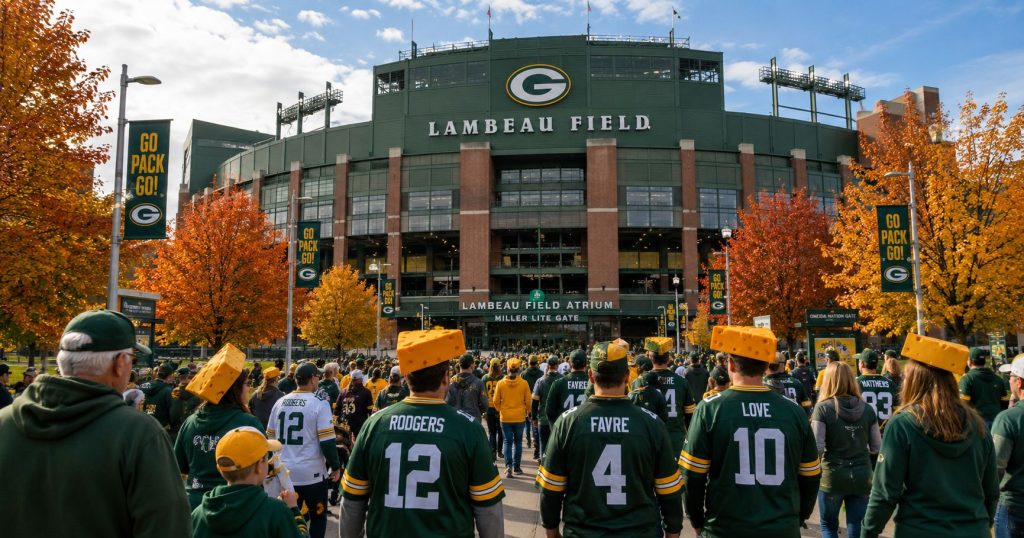
Lambeau Field opened in 1957 and has been renovated significantly since then, but it has never moved. It sits in a residential neighborhood on the west side of Green Bay — you can walk to it from houses that have been in the same families for decades, and the surrounding blocks fill up with tailgates in a way that blurs the line between the stadium and the neighborhood it occupies. The Lambeau Field experience is different from the experience at a stadium built in a suburban sports complex specifically because of this integration — the game isn’t an event you drive to from across the metro area, it’s something that happens in and around a place where people actually live.
The season ticket waiting list at Lambeau Field is one of the longest in professional sports — with wait times stretching to decades for new applicants. Season ticket holders pass their tickets down through families across generations, which is common knowledge but worth examining for what it reveals about the culture: for many Wisconsin families, Packers season tickets are treated as an inheritance. The tickets aren’t just entertainment — they’re a claim on something that belongs to the community, which is exactly what they legally are.
The frozen tundra reputation is real and earned. The 1967 NFL Championship Game — the Ice Bowl — was played at Lambeau in temperatures of minus 13°F, with wind chills approaching minus 48°F, against the Dallas Cowboys. The Packers won. That game became a foundational myth for the fanbase: a confirmation that Green Bay, a small cold city by any measurement, could win under conditions that would break most people. The Ice Bowl is referenced in Wisconsin football culture the way other regions reference wars or natural disasters — as evidence of what the place is made of.
The Cheesehead Identity
The Cheesehead hat — the foam wedge of yellow cheese worn on the head — originated in the late 1980s as a response to mockery from Chicago Bears fans who called Wisconsin residents “cheeseheads” as an insult. Ralph Bruno made the first one from a sofa cushion his mother was discarding, wore it to a Brewers game in 1987, and the image spread. By the time the Packers reached their Super Bowl runs in the 1990s, the Cheesehead had become one of the most recognizable fan accessories in professional sports — a piece of genuine folk culture that started as a reclaimed insult and became a symbol of pride.
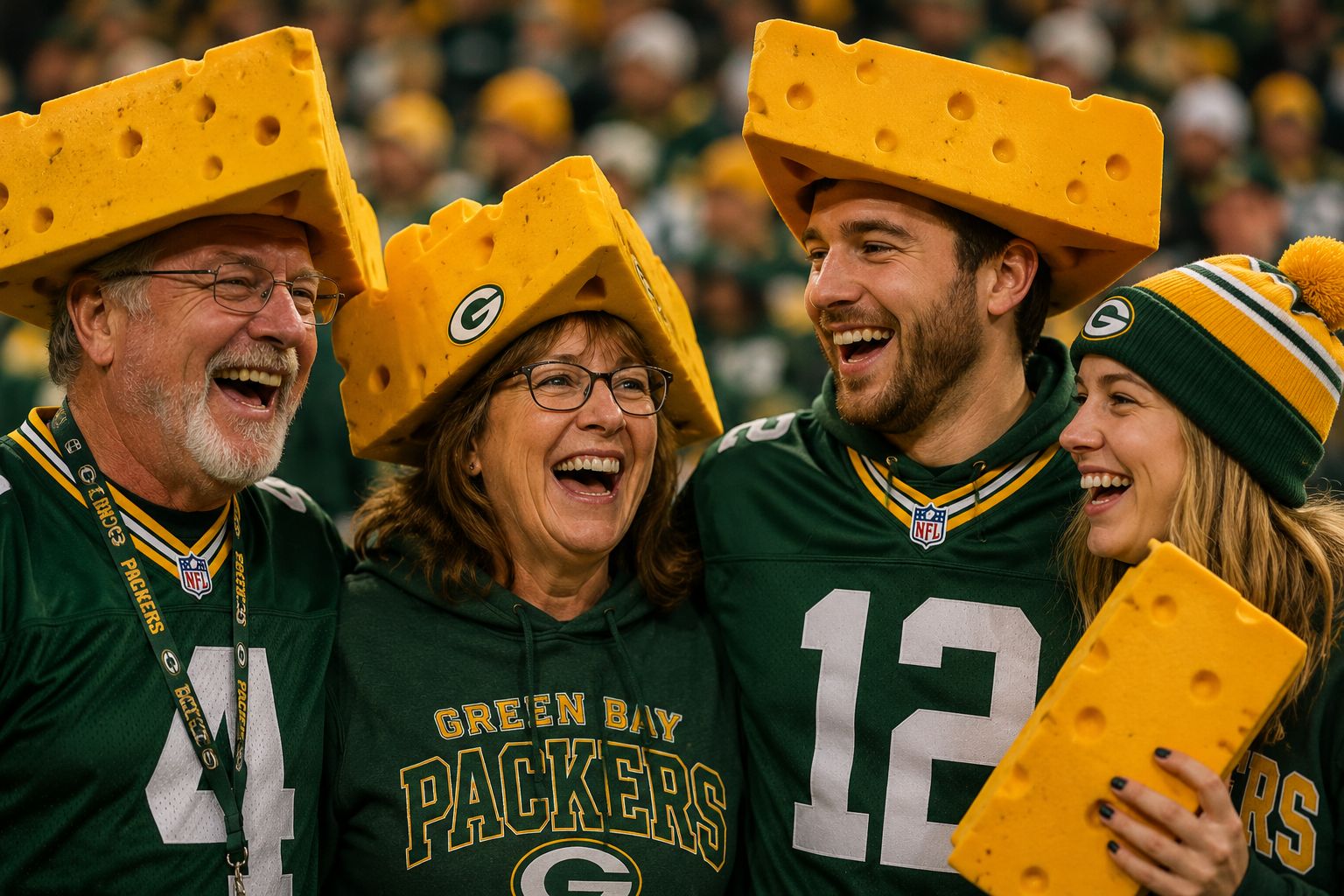
The Cheesehead phenomenon captures something essential about Packers fan identity: the willingness to own the thing that was meant to demean. Wisconsin is not a glamorous state in the national cultural imagination. Green Bay is not a major media market. The Packers play in the smallest city to host an NFL franchise by a significant margin. Packers fans know all of this and have constructed an identity that treats the smallness as a feature rather than a deficiency. The team belongs to the community precisely because the community is what it is — not despite it.
The Cheesehead has been worn by celebrities, referenced in films and television, exported to Packers fan bars in cities across the country and internationally. It’s worn at road games by traveling Packers fans in a way that communicates “we’re here, we’re loud, and we came from Wisconsin” — which is exactly what it was designed to say when someone first reclaimed it from an insult. In a culture that values authenticity above performance, the Cheesehead’s origin story is part of its meaning.
The Packers Dynasty Eras and What They Mean to the Fanbase
Packers fan identity is unusually stratified by era because the franchise has had three distinct periods of excellence separated by long stretches of mediocrity, and each era has its own defining players and emotional register for fans who lived through it.
The Lombardi era — roughly 1959 through 1967 — is the foundational mythology. Vince Lombardi arrived as head coach in 1959 and turned a franchise that hadn’t had a winning season in over a decade into a dynasty that won five NFL Championships and the first two Super Bowls. The players from this era — Bart Starr, Paul Hornung, Jim Taylor, Ray Nitschke, Willie Davis, Herb Adderley — are the names on the walls of Wisconsin bars and the numbers on throwback jerseys worn by fans who weren’t alive when those teams played. The Lombardi era gave the Packers their canonical identity as a franchise: disciplined, community-rooted, capable of winning in conditions that break other teams.
The Brett Favre era — 1992 through 2007 — brought the franchise back from three decades of irrelevance. Favre won three consecutive MVP awards from 1995 through 1997 and led the team to a Super Bowl XXXI victory over the New England Patriots in January 1997. His gunslinger style, his visible love of the game, and his durability — 297 consecutive starts — made him a figure of genuine affection in Wisconsin that has survived his complicated departure and subsequent return with the Vikings. Favre #4 jerseys appear regularly at Lambeau Field today, worn by fans who grew up watching him and haven’t shifted their allegiance to any current number.
The Aaron Rodgers era — 2008 through 2022 — produced a Super Bowl XLV victory over the Pittsburgh Steelers in February 2011 and four MVP awards, but it also produced something more complicated: a franchise star whose relationship with the organization deteriorated publicly, who demanded trades, and who ultimately left for the New York Jets. Rodgers’ departure split the fanbase in ways that are still active — some Packers fans see him as the greatest player the franchise has had since Lombardi’s players, others resent the manner of his exit. Both reactions are legitimate expressions of the same underlying investment. Jordan Love has taken the franchise into a new chapter, and the fanbase is in the process of determining how his era fits into the larger story.
Packers Fan Culture Outside Wisconsin
The Green Bay Packers have a national fanbase that is disproportionate to the size of their home market, and the reasons are worth understanding. The community ownership story travels — it’s the kind of narrative that resonates with people who have no geographic connection to Wisconsin but feel something when they learn that a small city of 100,000 people has kept an NFL franchise alive for a century through collective ownership. The underdog positioning relative to the major market franchises the Packers have competed against — the Cowboys, the Bears, the Giants — creates the kind of rooting interest that audiences outside the home market understand.
Packers fan bars exist in most major American cities and in several international ones. The traveling Packers fanbase is one of the more visible in the NFL — road game attendances at stadiums around the league regularly show significant Packers representation, with the green and gold identifiable in opposing stadium crowds in a way that communicates the fanbase’s geographic spread. A fan in San Francisco or Atlanta or New York who follows the Packers is typically someone who has a story about why — a Wisconsin connection, a grandfather who watched the Ice Bowl, a deliberate choice to follow the team that can’t be bought and sold by a billionaire with other interests.
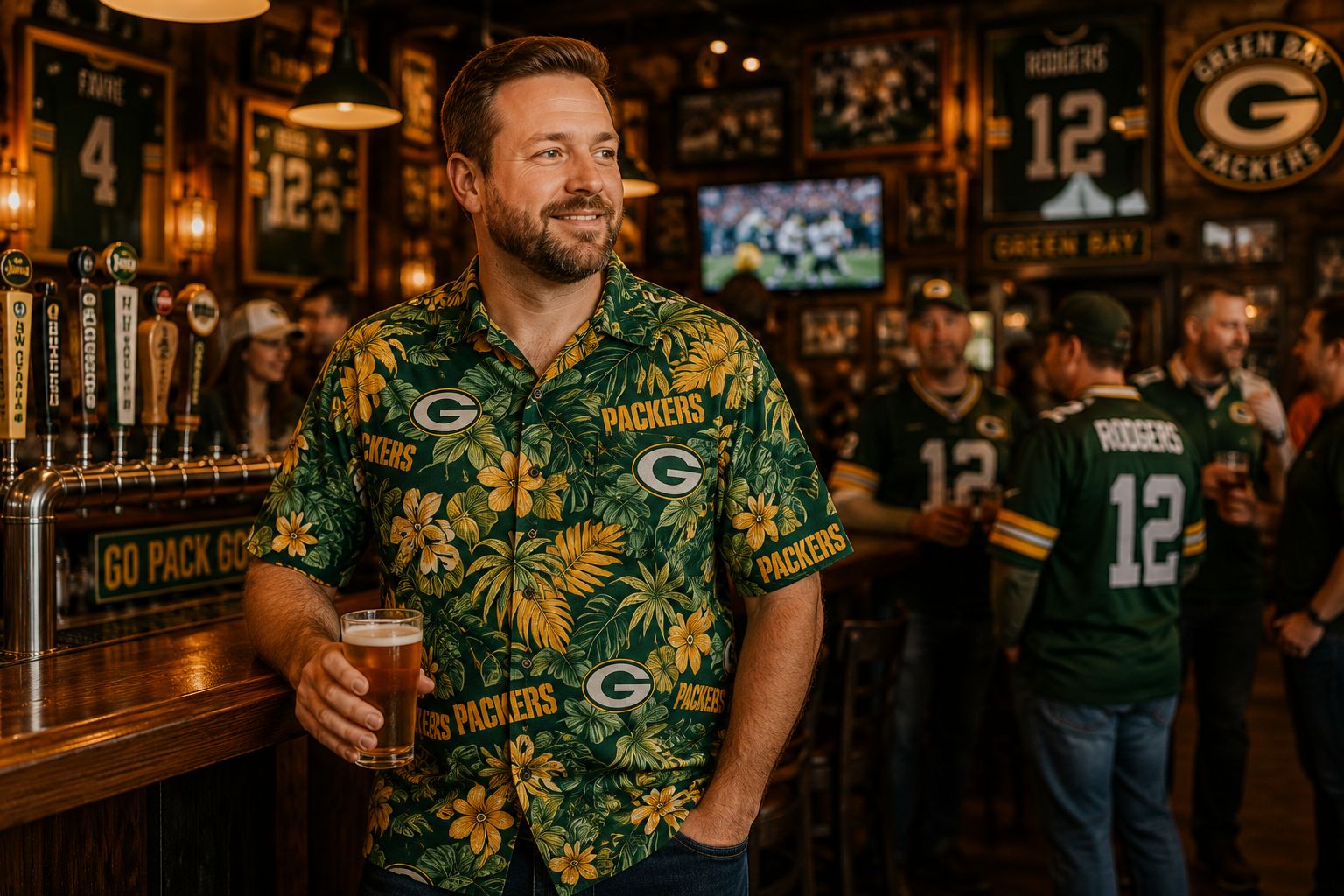
The green and gold travels partly because of the community ownership story and partly because of the color identity itself. Packers green and gold is one of the most recognizable combinations in professional sports — instantly readable as Green Bay to anyone with even passing familiarity with the NFL. Fan gear in green and gold all-over print works as an identity signal anywhere in the country in a way that more generic team colors don’t always manage. The Packers Hawaiian shirt collection in green and gold works specifically for this reason — it carries the identity clearly in any context, from a Packers bar in Chicago to a watch party in Los Angeles to a game day gathering in Milwaukee.
Tailgate Culture at Lambeau
The tailgate culture surrounding Lambeau Field is one of the more distinctive in the NFL because of the stadium’s integration with its residential neighborhood. The parking lots around Lambeau fill hours before kickoff, but the real tailgate scene extends into the surrounding streets and yards, where homeowners have been renting parking and hosting fans for decades. Some of the same families have been running informal tailgate operations in their driveways since the 1970s — charging for parking, setting up grills, running informal bars. This neighborhood-integrated tailgate culture doesn’t exist at suburban sports complexes built in the 1990s and 2000s, which are designed as standalone facilities rather than as part of a living neighborhood.
The Titletown district west of Lambeau — developed in recent years with hotels, restaurants, a brewery, and entertainment venues — has added a more commercial post-game destination to the existing neighborhood bar culture. Titletown Brewing Company, Lodge Kohler, and the Ariens Hill area have become the primary post-game gathering points for fans who want something beyond the bars on Lombardi Avenue. The coexistence of the old neighborhood tailgate culture and the newer Titletown development reflects the same dynamic that defines the franchise itself: deep community roots alongside the practical need to sustain a professional sports operation in a small market.
What Packers Fans Actually Wear
The jersey is the baseline at Lambeau Field, with the same era-stratification that defines the fan culture generally. Love #10 for fans of the current team. Rodgers #12 in home green or away white for fans whose primary era was the four-MVP run. Favre #4 for fans whose Packers fandom began in the 1990s dynasty. And in a fanbase with this kind of historical depth, throwback numbers from the Lombardi era — Starr #15, Nitschke #66 — are worn by fans who want to claim the franchise’s deepest roots. Reading the jersey numbers at a Lambeau Field crowd tells the story of how Wisconsin has been following this team across six decades.
Beyond jerseys, Packers fan apparel in green and gold has expanded in the post-Rodgers era as the fanbase has grown and diversified. Everyday wear formats — hoodies for Wisconsin winters, lightweight options for September and early October, and fan-designed pieces like the all-over print Packers Hawaiian shirt in green and gold — have become more visible in how Packers fans carry their identity outside game day. The Hawaiian shirt format works specifically in Wisconsin’s fan culture because the green and gold color combination is strong enough to carry the identity across an all-over print garment — it reads as Packers clearly even without a prominent logo placement, which is the baseline requirement for fan apparel to work as an identity signal in everyday contexts. For which designs in the collection hold up best on color accuracy and design coherence, the Packers Hawaiian shirt buying guide covers the full breakdown.
Frequently Asked Questions
Why do the Green Bay Packers have such a passionate fanbase?
The community ownership structure is the foundation. The Packers are the only publicly owned team in the NFL — a nonprofit corporation with over 500,000 shares held by more than 360,000 shareholders, most of them Wisconsin residents and fans. The team cannot be relocated, which changes the emotional investment in a fundamental way: Packers fans in Green Bay know the franchise will be there permanently, because they own it. That permanence, combined with the franchise’s century-long history in the same small city and the generational transmission of season tickets and fandom, produces a depth of loyalty that private ownership structures don’t generate in the same way.
What is the Green Bay Packers season ticket waiting list?
One of the longest season ticket waiting lists in professional sports, with wait times for new applicants stretching to decades. Season ticket holders pass their tickets down through families across generations — for many Wisconsin families, Packers season tickets are treated as an inheritance rather than a purchase. The waiting list reflects both the genuine demand for Lambeau Field attendance and the cultural weight attached to season ticket holding in Wisconsin, where having tickets isn’t just entertainment but a claim on community ownership of something that has belonged to the region for a century.
What does Cheesehead mean for Packers fans?
The Cheesehead hat — the foam wedge worn on the head — started as a reclaimed insult. Chicago Bears fans used “cheesehead” as a derogatory term for Wisconsin residents, and in the late 1980s a Wisconsin man named Ralph Bruno made the first foam cheese hat and wore it to a game. By the Packers’ Super Bowl runs in the 1990s, the Cheesehead had become one of the most recognizable fan accessories in professional sports. For Packers fans, it represents the willingness to own the thing that was meant to demean — a specifically Wisconsin form of pride that treats the state’s unglamorous reputation as a feature rather than a deficiency.
Who are the most beloved players in Packers history?
Bart Starr — quarterback of the Lombardi dynasty, two-time Super Bowl MVP — is the franchise’s canonical hero, the player who embodies the Lombardi era’s discipline and excellence. Vince Lombardi himself, though a coach rather than a player, is the figure the stadium is named after and the franchise’s defining figure. Brett Favre’s three consecutive MVP awards and Super Bowl XXXI victory made him the face of the franchise’s return to relevance in the 1990s, and his #4 is still worn regularly at Lambeau despite his complicated departure. Aaron Rodgers’ four MVP awards and Super Bowl XLV victory represent the franchise’s most recent dynasty. Ray Nitschke, Reggie White, Jerry Kramer, and Don Hutson hold significant places in the franchise’s deeper history.
What is the Ice Bowl?
The 1967 NFL Championship Game, played at Lambeau Field on December 31, 1967, between the Green Bay Packers and the Dallas Cowboys. The temperature at kickoff was minus 13°F, with wind chills approaching minus 48°F — the result of an equipment failure that left the field heating system unable to keep the turf from freezing. The Packers won 21–17 on a quarterback sneak by Bart Starr with 13 seconds remaining. The Ice Bowl is the central myth of the Packers fanbase — evidence, in the telling, that Green Bay is capable of winning under conditions that would break other teams and other cities.
How did the Green Bay Packers become community-owned?
In 1923, the franchise faced financial collapse. The community of Green Bay organized a public stock sale that raised enough money to keep the team operating. The model has been replicated in subsequent financial difficulties and stock offerings across the decades, with the most recent in 2021. The NFL’s current bylaws prohibit any new franchise from replicating this structure, meaning the Packers will remain the only community-owned team in professional football permanently. Over 500,000 shares are outstanding across more than 360,000 shareholders — most of them Wisconsin residents who bought shares for the certificate and the belonging, not for any financial return.
Written by Patrick Cooper · NFLHawaiianShirt.com Fandom & Culture
See also: Best Gifts for Green Bay Packers Fans · What to Wear to a Green Bay Packers Game · Best Green Bay Packers Hawaiian Shirts Ranked · What to Wear to an NFL Game