
fandom culture
Chiefs Kingdom Isn’t Built on Wins — It’s Built on Kansas City
May
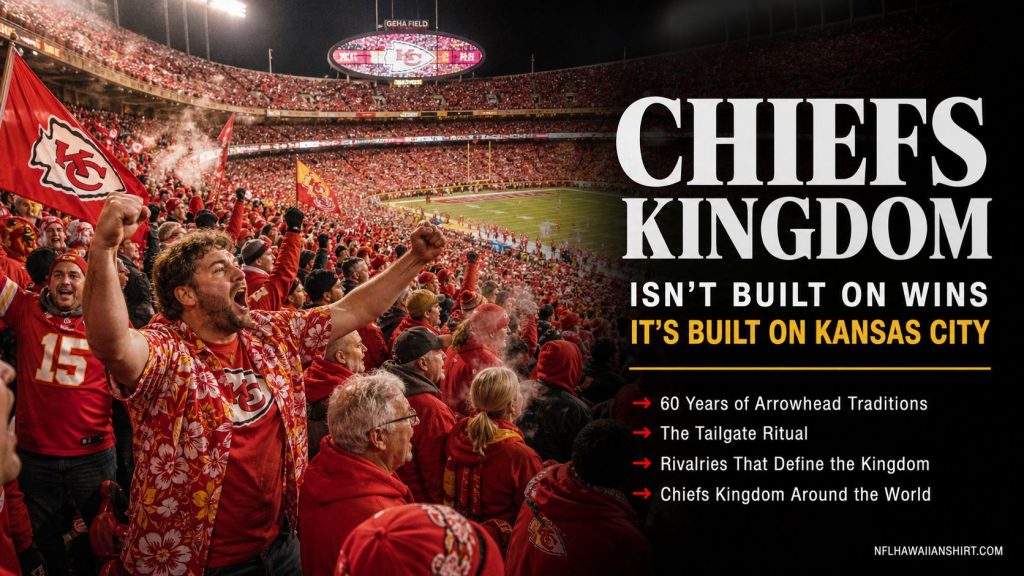
It’s third down, late in the fourth quarter, November at Arrowhead. The kind of cold that sits in your chest. A man three rows ahead hasn’t sat down since halftime — gray poncho, red hat worn to almost no color. When the defense lines up, something passes through the crowd without a signal. Everyone stands. The noise doesn’t build. It arrives. Sixty-some thousand people doing one thing together, and the opposing quarterback can’t hear his own line calls. That moment — not the scoreboard, not the championship banners — is what Chiefs Kingdom actually is. Chiefs Kingdom is the collective identity of Kansas City Chiefs fans — built over sixty years before it had a name, and the foundation of one of the most distinct fan cultures in the NFL.
Where Chiefs Kingdom Actually Comes From
The Kansas City Chiefs didn’t start in Kansas City. Understanding where Chiefs Kingdom comes from means starting sixty years back — before the dynasty, before Arrowhead, before the name existed. The franchise was born in Dallas in 1960 as the Texans, one of the original eight teams in Lamar Hunt’s American Football League. Hunt moved the team to Kansas City in 1963, and within a decade the Chiefs were playing on one of the most distinctive fields in professional football. Arrowhead Stadium opened in 1972 and immediately became something more than a venue. It became a civic institution in a city that had no other major professional sports franchise with the same tenure.
That context matters. Kansas City is not Los Angeles. It is not New York. It is a Midwest city with a working-class identity, a fierce local pride, and — for a very long time — not much to point to on the national stage except the Chiefs and some of the best barbecue in the country. The fanbase that developed in that environment didn’t need a dynasty to stay loyal. Through the Marty Schottenheimer years, through the painful playoff exits of the 1990s, through the Trent Green era, the seats at Arrowhead stayed filled. Pro Football Reference records show the Chiefs among the NFL’s most consistent home attendance franchises across multiple decades, including stretches when the team was decidedly mediocre. That consistency is not an accident. It is culture.
The name “Chiefs Kingdom” formalized something that already existed. It gave language to an identity that fans had been living for forty years before it became a marketing phrase.
Arrowhead: Ritual, Not Spectacle
The Guinness World Record came on September 29, 2014 — 137.5 decibels, Chiefs versus Patriots, louder than a commercial jet engine at close range. That number is the most cited fact about Arrowhead, and it is also the least useful one for understanding why game day at Arrowhead is different from game day anywhere else. The record is real and it belongs to Arrowhead. But the number misses the point. Arrowhead is not loud because fans decided to be loud. It is loud because of what happens before anyone takes the field.
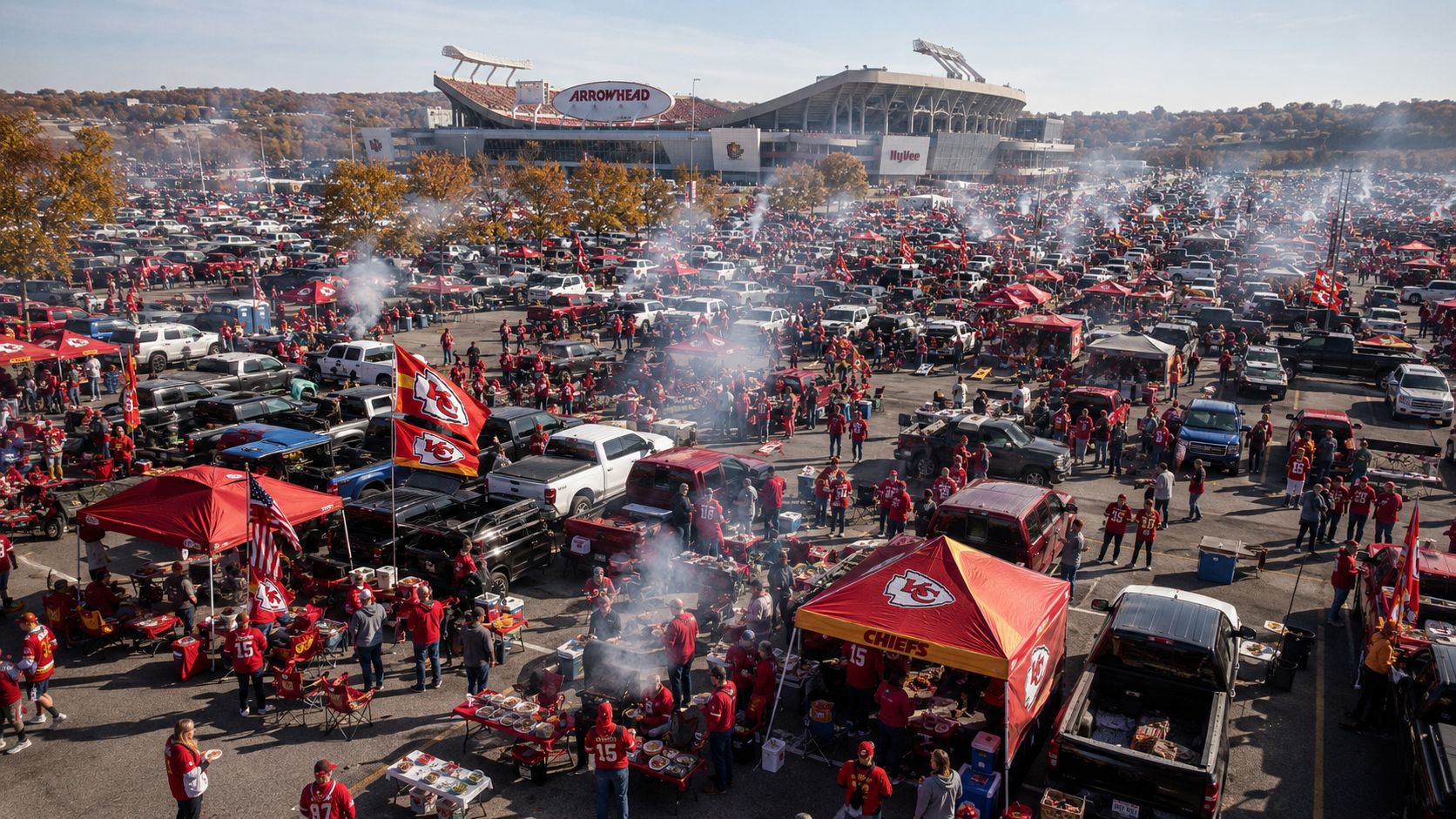
Tailgate lots at Arrowhead open five hours before kickoff. That is not a suggestion. For the families who have held the same season tickets for two and three generations, those five hours are not pre-game — they are the event. Kansas City-style barbecue is not incidental to the Arrowhead experience the way a hot dog is incidental to a ballpark. It is slow-smoked, set up with equipment, planned around the schedule. The parking lots become neighborhoods. The same people in the same spots, year after year. On Reddit’s r/KansasCityChiefs, threads about tailgate traditions run for hundreds of comments — regulars describing the exact sequence of their setup, who brings what, how long the brisket has been on. It is not food. It is ritual.
Inside the stadium, the crowd behavior follows patterns that new fans learn by watching, not by being told. The third-down defensive chant — the sustained, rhythmic noise that collapses opposing offenses — emanates from the upper deck, from the sections where the oldest season ticket holders sit. It moves downward through the bowl. New fans find themselves doing it before they understand why, because the crowd around them is already doing it. That is how oral culture works. That is why 137.5 decibels is a byproduct, not a goal.
The Mahomes Effect: Expansion Without Erosion
The Mahomes era did not create Chiefs Kingdom — but it stress-tested it in ways sixty years of loyalty never had. Before Patrick Mahomes, Chiefs season tickets were a modest investment. Resale value on StubHub was unremarkable. The fanbase was regional, loyal, and largely invisible to casual NFL observers outside the Midwest. Then 2019 happened, then Super Bowl LIV, then LVII, then LVIII. By 2023, secondary market data from SeatGeek and StubHub showed Chiefs tickets among the most expensive in the AFC as of the 2023–2024 seasons, with average resale prices during the regular season that would have been unthinkable a decade earlier.
New fans arrived in waves. The kind of fans who learned Mahomes’s name before they learned the names of the offensive linemen protecting him. Long-tenured season ticket holders noticed. The debate on Arrowhead Pride and in KC fan forums was direct: was the influx diluting the culture, or was the culture large enough to absorb it?
What appears to have happened — and what you can trace through community posts and Kansas City Star coverage of multi-generation ticket holders — is that the core fans didn’t leave. They stayed in their seats and kept doing what they had always done. The rituals persisted because they were embedded in the physical space, in the bodies of people who had been coming to that stadium since before some of the new fans were born. One long-running thread on r/KansasCityChiefs captures it plainly: veterans explaining the third-down sequence to newcomers, answering questions about tailgate etiquette, welcoming people into the pattern rather than gatekeeping them from it. The culture reproduced itself because it was worth reproducing. That is a different thing from a fanbase that only shows up when the team is winning.
Rivalries: What You Hate Tells You Who You Are
Every fanbase defines itself partly by what it opposes, and Chiefs Kingdom is no exception. Chiefs Kingdom’s two most meaningful rivalries are very different in age, origin, and character — but both are load-bearing parts of what it means to be a Chiefs fan.
The Raiders rivalry is the oldest and the most structurally embedded. Both franchises were founding members of the American Football League in 1960, assigned to the same division from the beginning. The tension between them predates the Super Bowl era. It is Midwest versus West Coast, red versus silver and black, a blue-collar community stadium culture versus the theatrical outlaw aesthetic that the Raiders have cultivated for six decades. There is no single incident that defines this rivalry because the rivalry is the whole history. The enmity is inherited, the way people inherit regional accents — not chosen, just there.
The Bengals rivalry is newer and more specific. The definitive moment arrived on January 30, 2022: AFC Championship Game, Arrowhead, the Chiefs lose 27-24. Patrick Mahomes throws for over 270 yards and it isn’t enough. Joe Burrow and the Bengals end Kansas City’s run at back-to-back Super Bowl appearances. For fans who had spent two years believing the Chiefs were simply going to keep winning, that loss landed differently than a regular-season loss ever could. The Bengals became the team that proved Chiefs Kingdom mortal. That kind of wound creates genuine rivalry — not manufactured, not marketing, not based on geography. Based on a specific afternoon that is not fully processed yet.
What Chiefs Fans Actually Wear
The sea of red at Arrowhead is a dress code no one enforces and everyone follows. On game day, you wear red. Not because the team asks you to — because not wearing red at Arrowhead would be as strange as not knowing the third-down chant. It is part of the shared agreement that makes the crowd a crowd rather than a collection of individuals.
The dress code is strict inside the stadium and loose everywhere else — and that gap is where most Chiefs fans’ wardrobes fall short. A jersey works at Arrowhead. It doesn’t work at a July barbecue in 95°F Kansas City heat, or at a Red Friday at the office, or at the kind of watch party that starts at 11am and ends well after midnight. The fans who figure this out early stop treating fan gear as single-context. They build a wardrobe that can carry the identity across all of it — game day, offseason, casual, formal-adjacent — without requiring them to change between situations. The Chiefs game day outfit guide covers what that actually looks like from Lot G through Power and Light. For a ranked breakdown of which designs hold up best across those contexts, the Chiefs Hawaiian shirt buying guide covers every option in the collection.
Chiefs Kingdom Beyond Kansas City
One of the less obvious effects of the Mahomes era is geographic. Chiefs Kingdom is no longer a regional identity — it is one of the league’s global brands. The NFL’s international series expansion through the early 2020s brought official Chiefs games to Frankfurt and London. Fan clubs in Mexico City, Tokyo, and across the UK activated around those appearances and stayed active. The Chiefs’ official international fan club registry lists chapters across five continents. The timing of the dynasty — coinciding precisely with the NFL’s most aggressive international push — meant that Chiefs Kingdom became many international fans’ entry point into the NFL entirely.
A watch party in Frankfurt for a noon Kansas City kickoff starts at 7pm local time. The fans who show up have set alarm notifications for score alerts before they went to sleep the night before. They’ve arranged their entire Sunday around a game happening in a timezone where it’s still Saturday night in KC. That is not casual fandom. That is the same devotion that built Arrowhead’s noise record, compressed into a living room in central Europe.
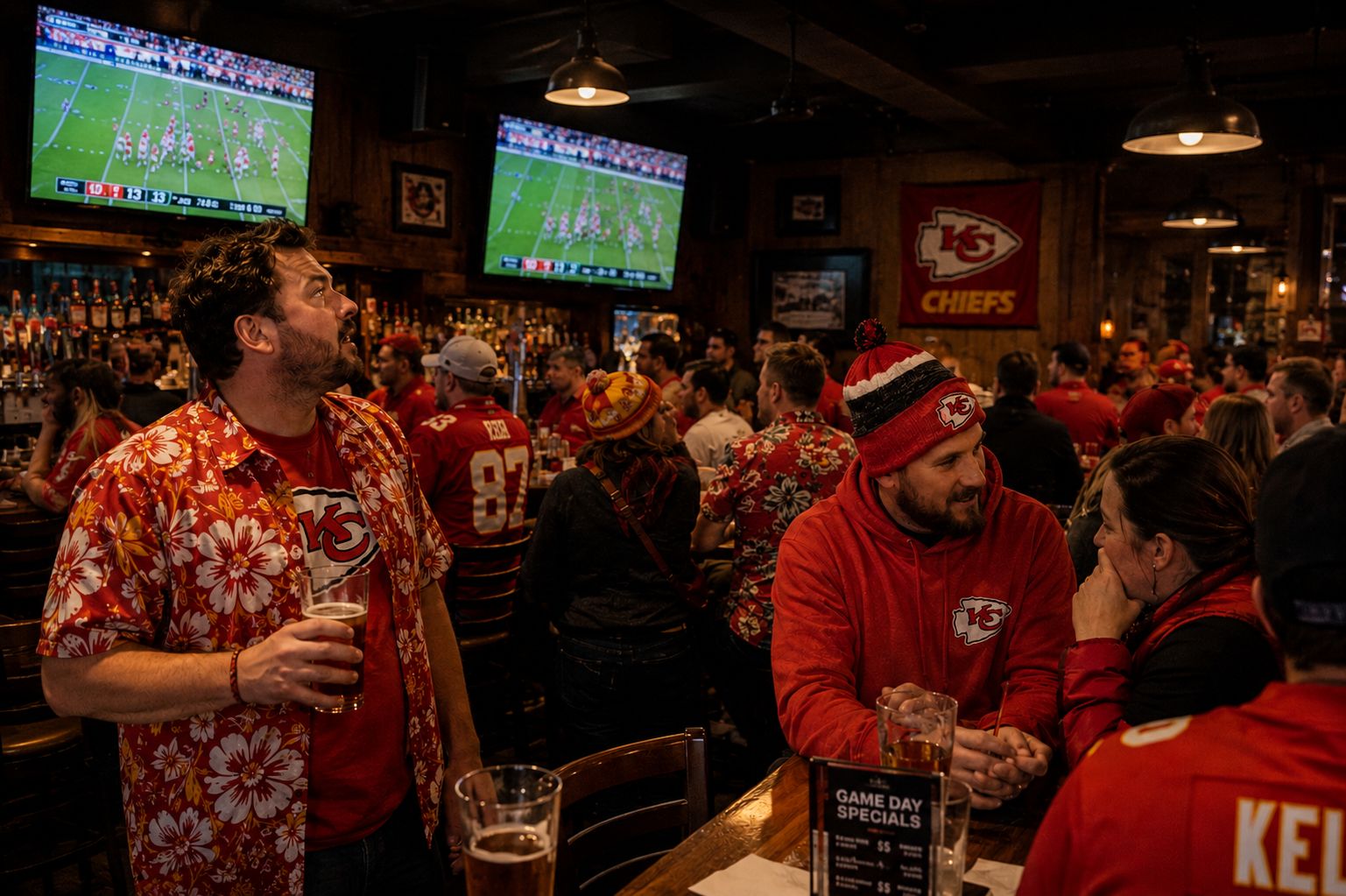
What that diaspora looks like in practice: threads on r/KansasCityChiefs where fans from Brazil and Germany ask the same tailgate questions that Missouri newcomers ask — and get the same patient, detailed answers from veterans. The visual markers of Kingdom membership travel because they mean something specific. Red gear, the arrowhead, the history behind both. For fans watching from outside Kansas City, the NFL game day outfit guide covers how to dress for every viewing context — stadium or watch party. For fans who want to carry that identity across contexts — from a watch party in London to a summer barbecue in Kansas City — the Chiefs fan gift guide covers what actually lands with someone who takes the Kingdom seriously, wherever they’re watching from.
The identity travels because it has enough texture to mean something 5,000 miles from Arrowhead — and that texture is what sixty years of culture-building looks like.
Frequently Asked Questions
What is Chiefs Kingdom and where did the name come from?
Chiefs Kingdom is the collective identity of Kansas City Chiefs fans — a term that captures the fanbase’s culture, loyalty, and community rather than just fandom in the casual sense. The phrase emerged organically from the fanbase before being adopted in official Chiefs branding. Its roots go back to the AFL founding era under Lamar Hunt, but it gained widespread national recognition during the Patrick Mahomes championship run beginning in 2019. The “Kingdom” framing reflects the sense that being a Chiefs fan is an identity, not just a preference.
Why is Arrowhead Stadium considered the loudest venue in the NFL?
Arrowhead Stadium holds the Guinness World Record for loudest crowd roar at a sports stadium, set on September 29, 2014, at 137.5 decibels during a Chiefs vs. Patriots game. The stadium’s bowl design — angled stands that direct sound inward rather than dispersing it — is a structural contributor. But the more important factor is behavioral: the third-down defensive chant is a practiced, coordinated behavior that the Arrowhead crowd has refined over decades. Noise at Arrowhead is a skill, not just enthusiasm.
How do Chiefs fans outside Kansas City connect with the Kingdom?
Chiefs fans outside the Kansas City area connect through official international fan clubs, active online communities like r/KansasCityChiefs, and the NFL’s international game series. The visual markers of Kingdom membership — red gear, the arrowhead, the specific culture built around Arrowhead rituals — travel because they carry enough meaning to be worth carrying. Many out-of-market and international fans describe the community as one of the more welcoming in the NFL, with veterans consistently helping newcomers understand the traditions rather than gatekeeping them. The identity is built to expand without eroding, and sixty years of evidence suggest it works.
Shop the full Kansas City Chiefs Hawaiian shirt collection →
Published by Patrick Cooper · NFLHawaiianShirt.com Fandom & Culture
See also: Best NFL Hawaiian Shirts Ranked · Kansas City Chiefs Father’s Day Gifts