
style outfit
What to Wear to a Green Bay Packers Game: The Lambeau Field Outfit Guide by Season
May
The first time I went to a Packers game in October, I wore a jersey over a hoodie and thought I was prepared. By the time the fourth quarter started, I was cold enough that I couldn’t focus on the game. Not because October in Green Bay is unusually brutal — it isn’t, not yet — but because Lambeau Field at night with Green Bay wind cutting through the open bowl has a way of dropping ten degrees faster than you expect. The second mistake I made was showing up to a Green Bay bar on Lombardi Avenue after a September game in full stadium kit and looking like I hadn’t transitioned out of the parking lot. Lambeau Field has a specific outfit problem that other NFL stadiums don’t have at the same scale: the weather range across the season is genuinely extreme, from 80°F in early September to single digits in January, and most fans plan one outfit for one temperature and end up either overdressed or underprepared. This guide covers every window of the Packers season and what actually works at each one.
The Lambeau Field Weather Problem
Green Bay, Wisconsin sits at 44°N latitude — roughly the same as northern France or southern Canada. The NFL schedule runs from early September through January, which in Green Bay means the season starts in summer heat and ends in genuine winter cold. The temperature swing between a Week 1 home opener and a January playoff game at Lambeau can be 60°F or more. No other outfit strategy works across that entire range, which is why Packers fans who attend games across the full season have developed a specific layering logic that fans from warmer markets don’t fully appreciate until they experience a late-December game in the upper sections of Lambeau’s open-air bowl.
Lambeau Field is partially open-air — the upper deck sections face the elements directly, and wind moving through the open bowl can make a 25°F day feel like 10°F in the exposed seating areas. The lower bowl holds slightly more heat from crowd density, but “slightly more” in January Green Bay still means cold by most standards. The frozen tundra reputation isn’t marketing — it’s a real outfit planning factor that determines whether you’re comfortable enough to pay attention to the game or spending the fourth quarter thinking about your car.
September Games: The Window Most Fans Get Wrong in Reverse
September at Lambeau runs warm — the first home games of the season regularly see temperatures above 70°F for afternoon kickoffs, and the synthetic turf surface holds heat in ways that make the field-level experience warmer than the air temperature suggests. The mistake in September isn’t under-dressing. It’s over-dressing out of habit because “Packers game” and “cold weather” are so linked in the cultural memory of this franchise that fans default to layering when they don’t need to.
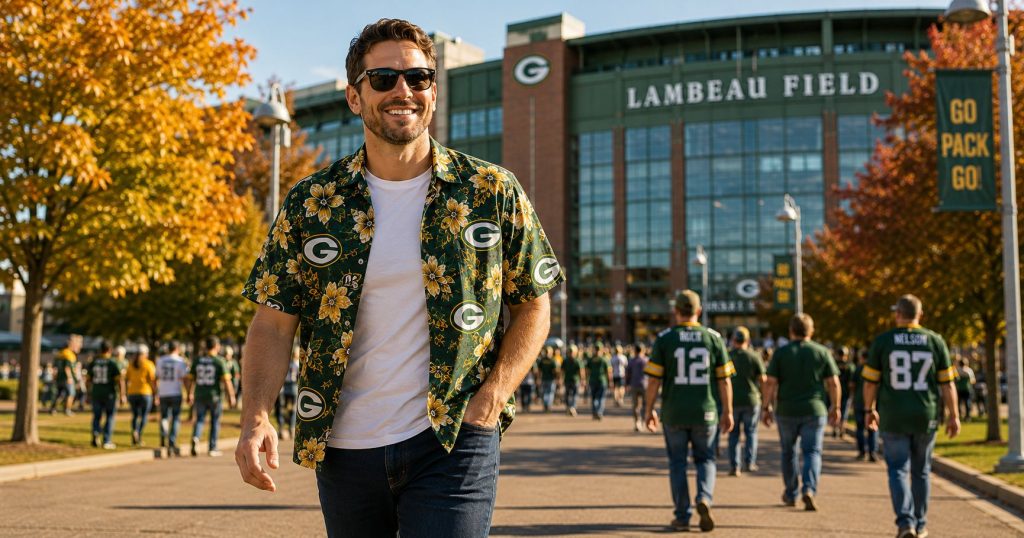
A jersey over nothing but a tee works fine for September afternoon games in the lower and mid sections. For evening kickoffs in late September, a lightweight layer under the jersey becomes useful as the temperature drops after dark — but the heavy hoodies and flannels that work in November are actively uncomfortable in September heat. A Packers Hawaiian shirt in green and gold all-over print worn open over a white tee is the specific September format that covers the tailgate in the Lambeau parking lots, the walk through the concourse, and the post-game bar on Lombardi Avenue or in the Titletown district without requiring a change. In the parking lots before a warm-weather home opener, worn open, it reads as deliberate Packers fan identity — it stands out in a crowd of Rodgers #12 and Love #10 jerseys specifically because it’s not the default.
September is also the one window in the Packers season where the Hawaiian shirt competes directly with the jersey on practical terms. The woven polyester construction breathes better than jersey mesh in direct afternoon sun, which matters when you’re standing in the Lambeau parking lots for three hours before kickoff in 75°F weather. The jersey wins for pure stadium atmosphere during the game. The Hawaiian shirt wins for the four hours outside the stadium that frame it.
October: The Transition Window
October at Lambeau is the most gear-complicated month on the Packers home schedule. Early October can still feel like September. Late October regularly drops into the 40s for evening games, and the temperature swing between a 1pm kickoff and the walk back to the parking lot can be 20 degrees. A 4:25pm kickoff in mid-October that starts in 55°F sunshine ends in 38°F dark, and an outfit that worked for tailgating at 2pm is inadequate by the time you’re walking back to your car at 8pm.
The answer for October is layers that can be adjusted independently rather than a single heavier item that’s either too warm early or too cold late. A Packers Hawaiian shirt over a lightweight quarter-zip as a base layer, with a midweight Packers hoodie or fleece that can be added for the second half — this gives three distinct temperature settings in one outfit without requiring anything to be stored in a bag. The Hawaiian shirt stays visible at the collar and through the open zip when the fleece is added over it, which is the specific visual that communicates “Packers fan with a real outfit” rather than “person wearing all their Packers gear simultaneously.”
For evening kickoffs in late October specifically, carry an extra layer into the stadium. The upper deck at Lambeau drops faster than the lower bowl in the second half, and being comfortable in the fourth quarter of a close NFC North game matters enough to justify the slight inconvenience of carrying a jacket in.
November and December: The Real Lambeau
This is the portion of the Packers season that built the frozen tundra reputation, and it deserves honest outfit advice rather than dramatization. November Lambeau averages in the mid-30s for afternoon games, with evening game temperatures regularly in the 20s. December brings the possibility of single-digit wind chills, and the upper deck sections at Lambeau are among the coldest outdoor seating environments in professional football when a December night game has wind.
Thermal base layers are not optional for November through December upper deck attendance. A fitted thermal or moisture-wicking long-sleeve under everything else is the foundational layer that makes the rest of the outfit work — without it, every layer above it loses effectiveness because cold air still reaches the body. Over the thermal: a heavyweight Packers hoodie or zip-up fleece as the middle layer. Over that: an insulated outer jacket — not a fashion jacket, an actual winter layer with real insulation. Hand warmers for the pockets. A Packers beanie rated for actual cold, not a fashion knit. These aren’t accessories for November Lambeau — they’re functional gear.
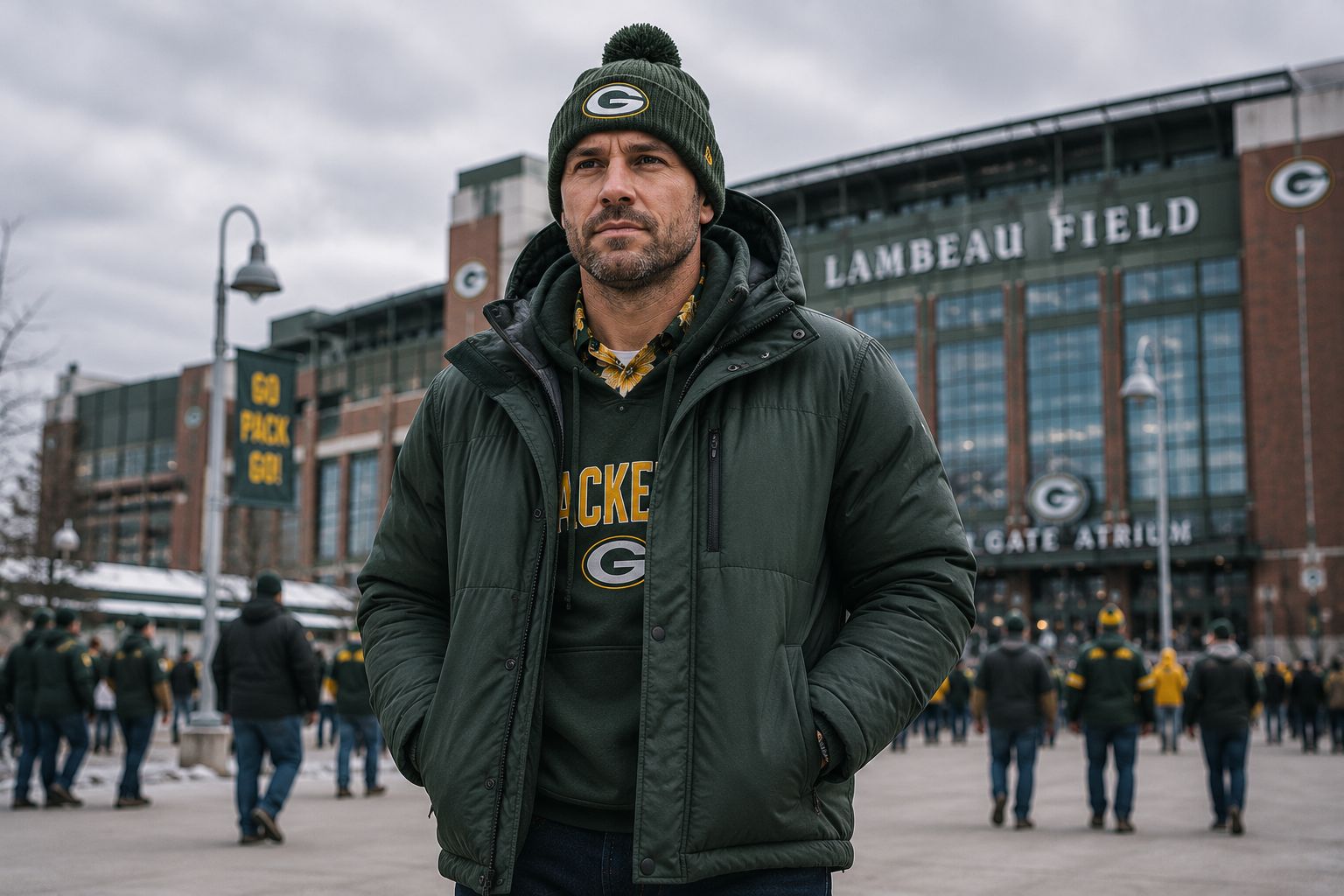
The Packers Hawaiian shirt still has a role in this window, but it shifts. For November and December games, the Hawaiian shirt works as a middle layer under the hoodie and jacket — the green and gold is visible at the collar and through open zippers when you’re inside the stadium concourse or at a bar after the game, and it handles the transition from the stadium into the post-game bar on Lombardi Avenue without requiring a change. Buttoned fully with dark jeans and boots at a bar in the Titletown district on a December Saturday night after a Packers win, it reads as a complete outfit. The stadium layers come off, and what’s underneath is already presentable.
January Playoff Games: The Specific Case
A January playoff game at Lambeau Field is a different experience from any regular season game at any other NFL stadium. The combination of historic playoff significance, the frozen tundra atmosphere the stadium has earned over decades of postseason games, and the genuine cold of a Green Bay January creates a specific dress code that most fans who haven’t attended one don’t fully anticipate. I’ve been in colder physical environments. I’ve never been somewhere where the crowd energy and the temperature were both at that level simultaneously.
For January playoff attendance specifically: thermal base layer is essential. Heavyweight insulated outer layer over everything. Packers jersey on top of the insulation layer rather than under it — in January at Lambeau, the jersey goes over the jacket for a specific reason: the crowd atmosphere at a playoff game requires the identity signal, and wearing it under a coat defeats the purpose. Waterproof boots if there’s any chance of snow. Heat packets in gloves or pockets. A balaclava or heavy neck gaiter under the hat for the exposed upper deck.
The Hawaiian shirt doesn’t have a stadium role in January Lambeau. It’s what you wear at the post-game bar after the win — or after the loss, which at Lambeau has happened enough times in memorable playoff games that both contingencies deserve equal outfit planning.
The Post-Game Bar: Green Bay After Lambeau
Green Bay’s post-game bar scene is geographically concentrated in ways that make outfit transitions specific and worth thinking about. Lombardi Avenue runs directly toward the stadium and fills up before and after games. The Titletown district west of Lambeau has become the primary post-game destination in recent years — Hinterland Brewery, Lodge Kohler, the Ariens Hill area. Downtown Green Bay on Washington Street has bars that run post-game well into the night. These are all within a mile or two of Lambeau, which means fans are walking from a cold outdoor stadium to heated indoor bars in quick succession.
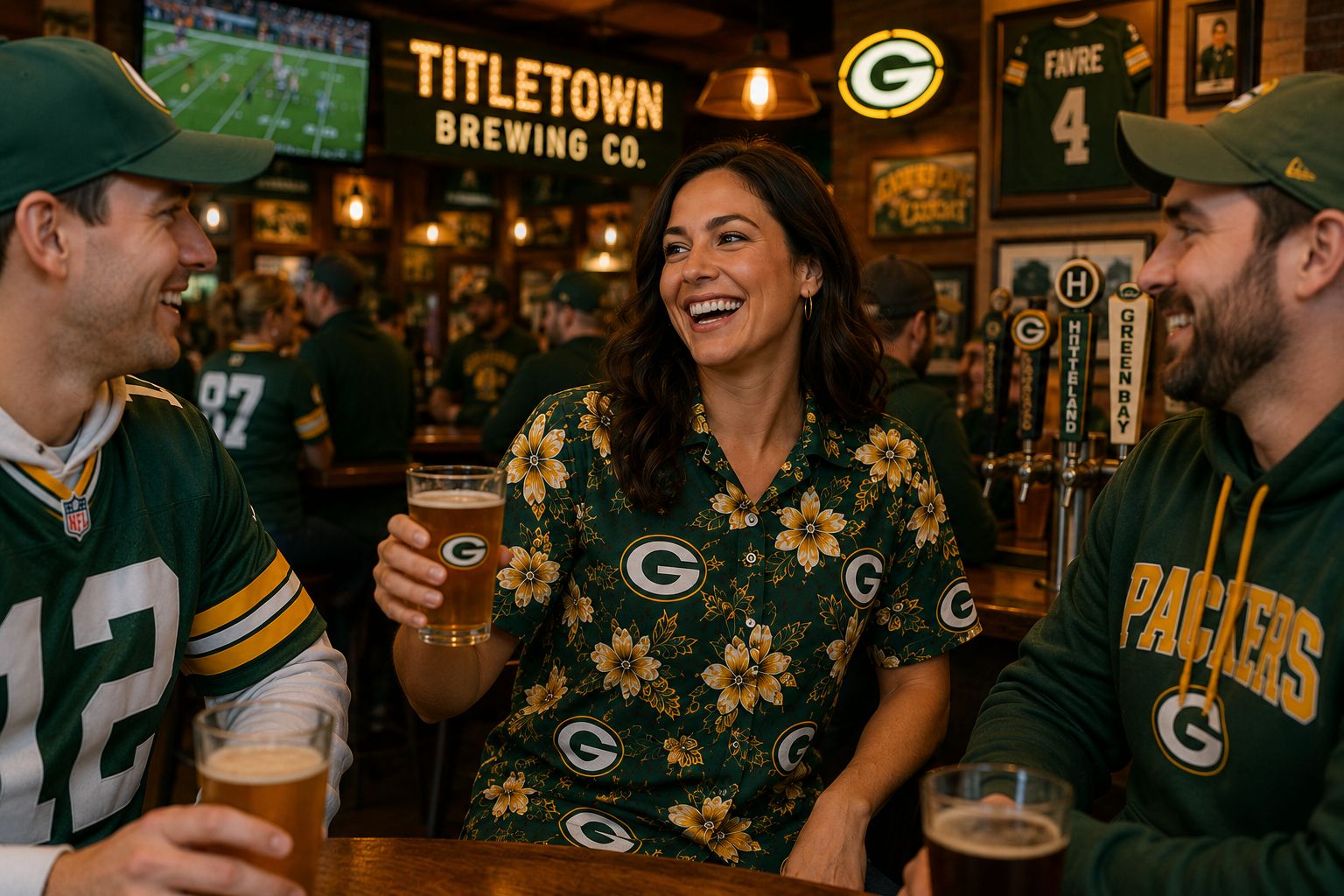
A jersey over multiple winter layers reads as slightly overdressed at a sit-down bar in Titletown, particularly in the dinner hours. The transition problem is the same as at other stadiums — stadium kit works in the stadium, but carries the game with it in a way that doesn’t always translate naturally to a bar or restaurant. A Packers Hawaiian shirt buttoned fully over whatever base layers you’re wearing underneath, with the stadium outer layers removed at the door, handles this transition. The green and gold still communicates Packers fan clearly, but it reads as a deliberate outfit rather than someone who hasn’t changed since the parking lot. In January, the Hawaiian shirt as an inner layer under the stadium gear means it’s already there when you need it — no bag, no change required.
Browse Packers Hawaiian shirts for game day and post-game wear →
When the Jersey Wins
To be direct about this: the Packers jersey wins in specific situations where the Hawaiian shirt doesn’t compete.
A January playoff game at Lambeau Field — the specific environment this stadium has become iconic for — is the clearest case. When the crowd energy at a postseason game in Green Bay is at that level and the temperature is in the single digits, wearing full Packers game-day kit is appropriate to the occasion. The Hawaiian shirt at a January playoff game at Lambeau reads as slightly underprepared for both the weather and the moment. This is the environment the jersey was designed for.
Road games at hostile venues — AT&T Stadium in Arlington against Dallas, MetLife Stadium against the Giants or Jets — are the other clear jersey situation. When you’re a Packers fan in a stadium full of the opposing team’s fans, the jersey signals harder and more directly than the Hawaiian shirt. The legible player number in green and gold communicates exactly what it needs to communicate in that environment.
Regular season home games from mid-November through December in the upper deck are also jersey territory for most fans — the cold makes the full layering system necessary, and the jersey as an outer identity layer over insulation is the standard Lambeau cold-weather formula. The Hawaiian shirt’s role in this window is as the transition piece into the post-game bar, not as the primary game-day statement.
What to Wear to a Packers Game: Quick Reference by Month
| Month | Avg Temp at Lambeau | Recommended Outfit | Hawaiian shirt role |
|---|---|---|---|
| September | 65–75°F | Hawaiian shirt open over tee, or jersey over tee | Primary — tailgate through post-game bar |
| Early October | 50–60°F | Hawaiian shirt + quarter-zip base, hoodie available | Primary layer, hoodie over for cold spells |
| Late October | 38–48°F | Thermal + Hawaiian shirt + Packers fleece + jacket | Middle layer — visible at collar and bar |
| November | 28–38°F | Thermal base + heavyweight hoodie + insulated jacket | Inner layer for post-game bar transition |
| December | 18–28°F | Full winter system — thermal + fleece + insulated jacket + beanie | Inner layer, buttoned at bar after game |
| January (playoffs) | 10–20°F | Full winter system + jersey over jacket + hand warmers | Post-game bar only — not stadium role |
Frequently Asked Questions
What should I wear to a Green Bay Packers game at Lambeau Field?
It depends almost entirely on the month. September afternoon games can reach 75°F — a jersey over a tee or a Hawaiian shirt worn open is appropriate. Late October evening games drop into the high 30s by the fourth quarter — thermal base layer under a hoodie, with an outer layer available. November through December requires treating it like a Wisconsin winter day with the addition of Packers identity gear on top. January playoff games need full winter gear including thermal underlayers, insulated jacket, and waterproof boots. Most fans who come underprepared are visiting from warmer markets and underestimate how cold the upper deck gets after dark in late season.
Is a jersey or a Hawaiian shirt better for a Packers game?
Depends on the month and where you’re sitting. The jersey is the right call for January playoff games at Lambeau, for November and December upper deck games in full cold-weather gear, and for road games at hostile venues where the identity signal needs to be clear. The Hawaiian shirt works better for September and early October games where the tailgate-through-post-game arc covers temperatures that don’t require heavy layering, and for the post-game bar transition in any month — buttoned fully under stadium layers, it’s already there when you need it at Titletown or on Lombardi Avenue after the game.
How cold does it get at Lambeau Field in winter?
December games average 18–28°F in Green Bay, with wind chills capable of pushing the felt temperature into single digits in the upper deck sections. January playoff games have historically been played in temperatures below 10°F. The upper deck is more exposed than the lower bowl, which holds more heat from crowd density. Coming from a warmer market and attending a November or December game for the first time, most fans underestimate how cold the upper sections get after dark in the second half. Thermal underlayers are functional gear for late-season Lambeau attendance, not optional additions.
What do Packers fans wear to tailgates?
September tailgates in the Lambeau parking lots run warm — green and gold in any format works, and the Hawaiian shirt specifically handles the temperature and activity level of a parking lot tailgate better than heavy game-day kit. For October and November tailgates, the layering system starts before you leave the car — the parking lots outside Lambeau are exposed to Wisconsin wind in a way that makes tailgating in November a genuine cold-weather activity, not just a pre-game warm-up. By December, a tailgate at Lambeau is a winter outdoor activity that requires the same gear as any other winter outdoor activity in Wisconsin, with green and gold added.
What do you wear to a post-game bar in Green Bay?
Lombardi Avenue bars and the Titletown district bars fill up immediately post-game and transition from stadium-intensity crowd to a more relaxed bar atmosphere over the next hour or two. Full stadium kit — jersey visible over multiple winter layers — is fine immediately post-game when the crowd is still at that energy. As the night progresses, shedding the outer stadium layers and being in a Packers Hawaiian shirt buttoned fully underneath transitions naturally. It communicates Packers fan clearly without reading as someone who hasn’t left game-day mode three hours after the final whistle.
Can you wear a Hawaiian shirt to a Packers game in November or December?
Yes — as an inner layer under the winter gear, not as a standalone top. In November and December, the Hawaiian shirt works specifically as the transition piece: worn under the hoodie and insulated jacket for the game, then revealed when you come inside to the Titletown bars or the Lombardi Avenue post-game spots. The green and gold is visible at the collar when the jacket is zipped up in the stadium, and fully visible when the outer layers come off inside. It’s not the right standalone piece for the Lambeau upper deck in December, but as the piece that bridges cold-weather game attendance and post-game bar wear, it fills a gap nothing else in the Packers apparel range covers as well.
Written by Cliff Straham · NFLHawaiianShirt.com Style & Outfit
See also: What to Wear to an NFL Game: 12 Outfit Decisions That Actually Work · Best Gifts for Green Bay Packers Fans · Best Green Bay Packers Hawaiian Shirts Ranked · Green Bay Packers Fan Culture & Traditions