fandom culture
Steeler Nation: The Fan Culture, Traditions, and Identity That Outlasted the Dynasty
Jun
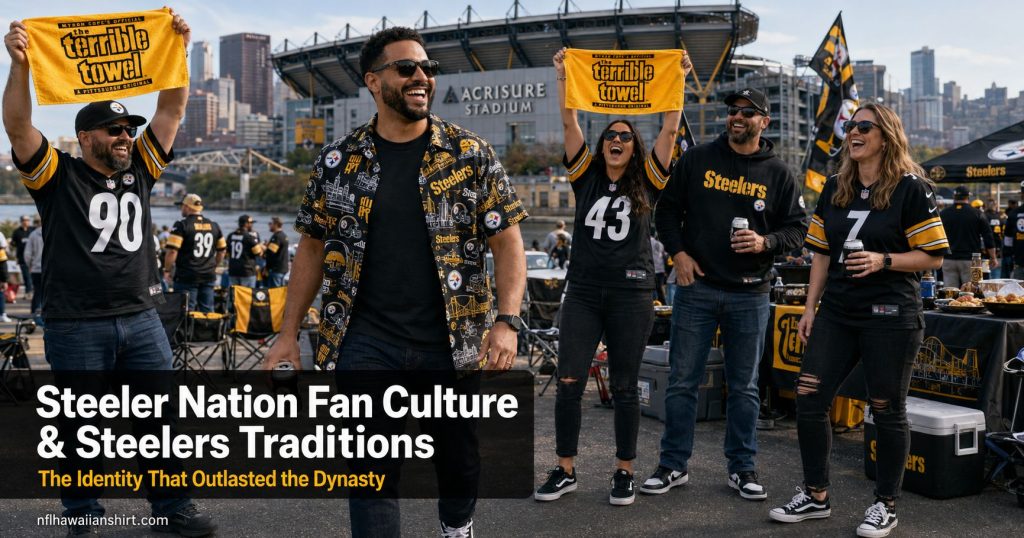
I’ve been in the North Shore lots at 7am before a noon kickoff, watching Pittsburgh materialize out of the river fog — black and gold everywhere, Terrible Towels staked into coolers, the Allegheny running cold and dark behind the stadium. I’ve been in Steelers bars in Charlotte and Phoenix, watching fans who have never lived within 300 miles of Pittsburgh treat game day like a civic obligation. Steeler Nation is not a marketing phrase. It describes a genuine Steeler Nation fan culture — a fanbase that moved with a city’s industrial history and replanted itself across America, carrying the black and gold like a kind of faith. What follows is an attempt to explain how that happened, and what it looks like in 2026.
The Terrible Towel: How a Radio Stunt Became a Ritual Object
Myron Cope invented the Terrible Towel on his radio show in December 1975, ahead of a playoff game against the Baltimore Colts. His instruction was simple: bring a gold towel to Three Rivers Stadium and wave it. No franchise committee approved it. No marketing department developed it. A radio broadcaster in Pittsburgh told his listeners to wave a towel, and they did, and the Steelers won, and something that had no reason to persist somehow became one of the most recognizable symbols in professional sports.
What makes the Terrible Towel specific to Steeler Nation isn’t its existence — plenty of teams have signature gear. It’s the relationship fans have with the object itself. The Towel gets waved, not worn. It travels to road games in opposing stadiums, where Steelers fans often make themselves impossible to miss in the loudest sections. It gets passed between generations: a grandmother’s game-day towel handed to a grandchild who has never been to Pittsburgh. The object carries weight beyond its function as a piece of fabric because it was earned through collective action rather than sold through a merchandising deal.
The distinction between official and unofficial Towels matters in ways that surprise outsiders. Myron Cope’s rights to the Terrible Towel were left to Allegheny Valley School, a Pittsburgh-area institution serving people with intellectual and developmental disabilities. Official Towel sales benefit AVS directly. Steeler Nation members who have been following this team for decades tend to know this. A knockoff Towel at a gas station is not the same object to someone who understands its history, and the distinction reads as a kind of Steeler Nation literacy test — not enforced by anyone, but noticed.
Six Super Bowls and What They Did to Fan Expectations
The Pittsburgh Steelers have won six Super Bowls, including four in six years during the 1970s dynasty, becoming the first NFL team to reach six Super Bowl victories. Understanding Steeler Nation in 2026 requires understanding what winning at that scale does to a fanbase’s emotional architecture.
Chuck Noll built the 1970s dynasty from the ruins of a franchise that had never won anything. Four Super Bowls in six years — IX, X, XIII, XIV — with Terry Bradshaw orchestrating the offense and Franco Harris grinding yards when the game was on the line, established a baseline expectation in Pittsburgh that has never fully been revised downward. The Cowher era added Super Bowl XL in February 2006, the franchise’s fifth. Roethlisberger’s second championship followed three years later in Super Bowl XLIII, with Troy Polamalu emerging as the defensive face of a new Steelers era. Six total. Then nothing.
The absence of a championship since 2009 is not something most Steeler Nation members talk about the way fans of perpetually losing franchises talk about drought. The expectation is that a Steelers team good enough to compete is the minimum acceptable outcome — not because fans are arrogant, but because that expectation was built over fifteen years of evidence that winning was achievable, repeatable, and specifically tied to Pittsburgh. A mediocre Steelers season doesn’t feel like bad luck. It feels like something went wrong.
Acrisure Stadium and the North Shore: Where It All Happens
The stadium that Pittsburgh fans knew as Heinz Field opened in 2001 and became Acrisure Stadium in 2022 through a naming rights deal that most Steelers fans have accepted with varying degrees of resignation. The name changed; the place didn’t. The North Shore setting — the Allegheny River running behind the stadium, the Pittsburgh skyline across the water, the bridges connecting the North Side to downtown — is one of the more visually striking stadium sites in American professional sports, and it functions as a geographic anchor for Steeler Nation identity in a way that the stadium name never could.
The tailgate culture on the North Shore starts before dawn for big games. I’ve been in those lots when it’s still dark, when the river air is cold enough that breath is visible and the yellow towels are the brightest things in the parking lot. The parking lots fill in a specific order that regulars understand and first-timers discover by instinct. Carson Street in South Side is where the post-game continues — bars running until the crowd disperses, which on a Steelers home game day means late.
The transition from Heinz Field to Acrisure Stadium created a specific cultural friction that reveals something about how Steeler Nation relates to the place. Fans who have been going to games for thirty years don’t call it Acrisure. The corporate name didn’t erase the identity the stadium accumulated — it just created a gap between official language and fan language that the fanbase navigated by choosing to keep using the old name in conversation while knowing they mean the same building. For how the physical experience of game day maps onto what to wear from the lots to the seating bowl and back to Carson Street, the Steelers game day outfit guide covers the zone-by-zone arc in detail.
The Steel Curtain Defense and the Identity It Built
The 1970s Steelers defense — Mean Joe Greene, Jack Lambert, Jack Ham, Mel Blount — was not just a championship-winning unit. It was the primary artifact that shaped what Steeler Nation expects from a Pittsburgh team at a fundamental level. The Steel Curtain was the mechanism through which four Super Bowls were won, and the mental model it established for how football is supposed to be played in Pittsburgh has never been fully updated.
Steelers fans in 2026 still evaluate modern Pittsburgh defenses through the Steel Curtain lens. A defense that doesn’t impose physical pressure, that allows opposing offenses to operate comfortably, feels like a cultural failure in Pittsburgh in a way that it might not in other markets. The league has moved toward pass-first offense and rule changes that protect quarterbacks and receivers in ways that make the Steel Curtain’s physical style of play increasingly illegal. Steeler Nation lives with this contradiction every season: the identity is defense-first, the era is offense-first, and the gap between those two realities produces a specific kind of weekly frustration that fuels the sports talk radio ecosystem and the parking lot debates in equal measure.
Mean Joe Greene’s career arc — the most recognizable player in franchise history, an eleven-time Pro Bowl selection, the symbol of a defense that defined a decade — established a standard of individual excellence that Steeler Nation measures subsequent players against. Jack Lambert, who played the middle linebacker position with an aggression that occasionally crossed into intimidation, is the template for what a Steelers defensive player is supposed to look like. Chuck Noll, the coach who built both the 1970s dynasty and the player development philosophy that produced it, remains the standard by which every subsequent Steelers coach is evaluated. Bill Cowher added another Super Bowl to the franchise’s history and brought a sideline personality that matched the city’s self-image. Mike Tomlin spent nineteen seasons without a losing record before stepping away after the 2025 wild card loss to Houston.
The Pittsburgh Diaspora: How Black and Gold Traveled
Steeler Nation became national not because Pittsburgh became bigger, but because Pittsburghers moved — and carried the black and gold with them.
The mechanism is specific. The Pittsburgh steel industry’s decline through the 1970s and accelerating into the 1980s contributed to a major population movement out of Western Pennsylvania. Workers and their families left Western Pennsylvania for cities where work was available — Charlotte, Phoenix, Atlanta, Chicago, Houston — and they brought their team with them. The Steelers happened to be winning four Super Bowls during the first wave of that movement, which meant that people were leaving Pittsburgh with a championship identity in addition to a geographic one.
The second generation — fans who grew up in Charlotte or Phoenix with parents who remembered Pittsburgh — inherited fandom the way other people inherit religion: through family practice rather than personal choice. The grandfather who worked in the mills, who watched the 1970s dynasty on a small television in Aliquippa or McKeesport before the move, passed the Terrible Towel forward. The grandchild waves it in a Steelers bar in a city where no one around them has ever been to Pittsburgh.
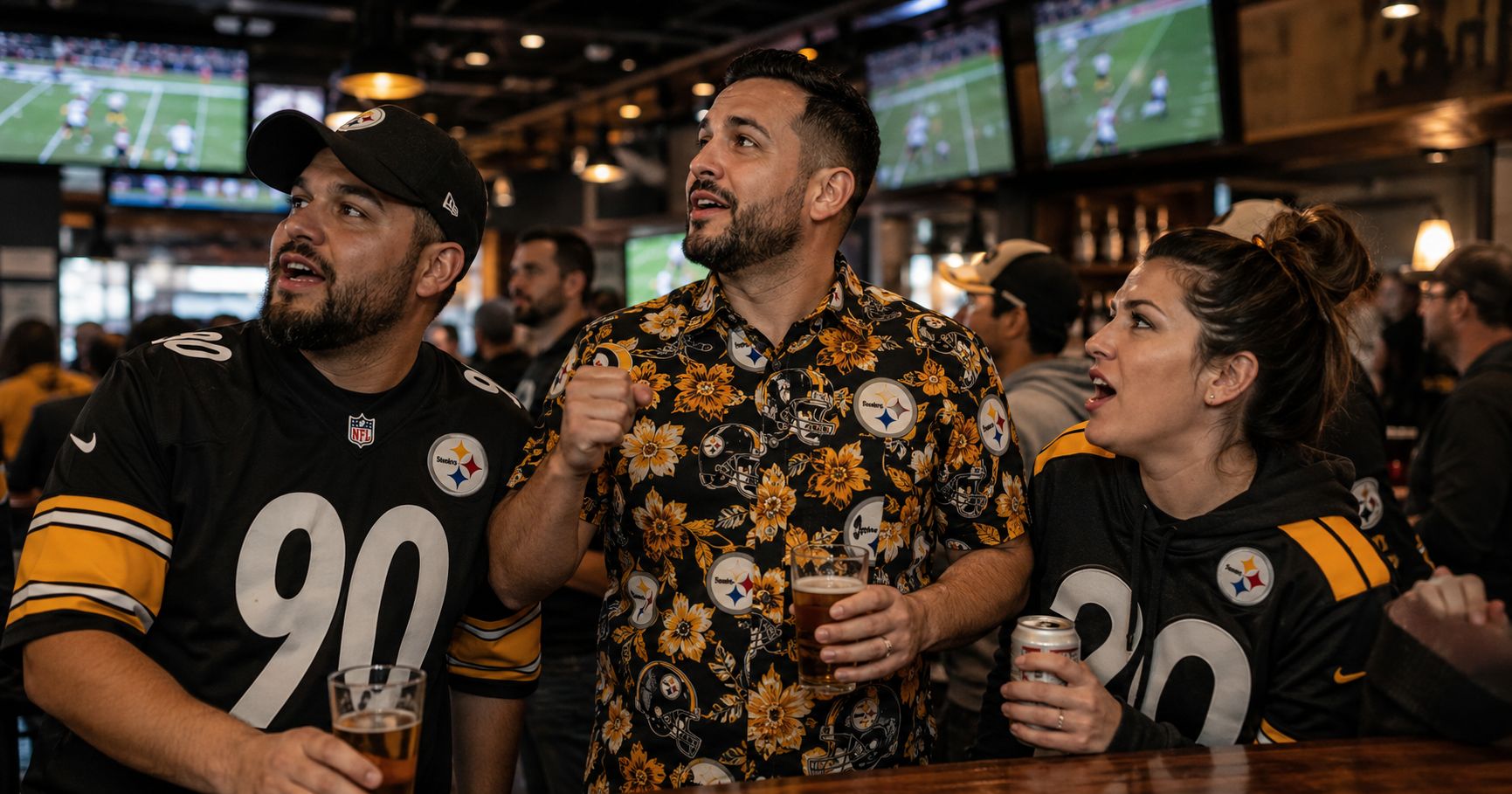
The result is a Steeler Nation fan culture with an unusual ratio of geography to identity. The Steelers are widely recognized for one of the NFL’s most visible road followings — visiting fans who travel specifically to wear black and gold in stadiums across the AFC North and beyond. In cities without NFL teams, Steelers bars exist as social infrastructure. A Steelers fan in Raleigh or Denver doesn’t need to explain their team. The identity is legible across the country in a way that most regional sports fanbases aren’t.
What Rivals and Critics Say About Steeler Nation
The honest version of a Steeler Nation cultural guide includes the external view — what rival fans say, and what isn’t entirely wrong about it.
The Baltimore Ravens and Cleveland Browns fans, who interact with Steeler Nation most regularly across the AFC North, hold specific critiques that predate current rivalries. The loudness is the first one — the sense that Steeler Nation occupies space in every opposing stadium in numbers that suggest a fanbase that travels as much to be seen as to watch football. This is partly true and partly the result of genuine diaspora geography: a Steelers fan in Baltimore for a road game isn’t a tourist. They may have lived in Maryland for twenty years and kept the black and gold as primary identity.
The bandwagon accusation is more complicated. National success creates national fans, and some portion of Steeler Nation’s scale is attributable to people who chose Pittsburgh because Pittsburgh was winning rather than because of any inherited or geographic connection. This is true of every successful franchise. The accusation lands harder on Steelers fans because the scale of the diaspora makes it difficult to distinguish organic growth from bandwagon growth from the outside.
The Roethlisberger era is where the external critique becomes most pointed. For rival fans, that era remains complicated — not only because of the wins, but because of how public perception of that period has evolved over time. Steeler Nation’s relationship to that legacy is not monolithic, and the fanbase contains fans who engage with the complexity honestly alongside fans who prefer not to. Both groups exist. The honest acknowledgment is that the dynasty’s modern reputation is something Steeler Nation navigates rather than resolves.
Steeler Nation in 2026: A Dynasty Fanbase Without Recent Dynasty Results
The Pittsburgh Steelers entered the 2026 season with Aaron Rodgers returning for his second year as starter and what he announced would be his final NFL season. Rodgers returned on a one-year deal for what he described as his farewell tour, reuniting with new head coach Mike McCarthy — the same coach who spent thirteen seasons with Rodgers in Green Bay and won a Super Bowl with him after the 2010 season. When asked at OTAs if this was his final season, Rodgers was direct: “Yes. This is it.”
The 2026 Steelers carry a particular tension: a future Hall of Fame quarterback in his farewell season, a new coaching era with a coach who knows that quarterback better than anyone, and a fanbase still judging the present through dynasty-era expectations. The next generation waits in the background, the franchise’s longer-term identity question still forming. What hasn’t changed is the identity itself. Steeler Nation in 2026 doesn’t need a Super Bowl run to function as a cultural force. The six Lombardi Trophies, the Steel Curtain legacy, the Terrible Towel ritual, the diaspora bars from Charlotte to Phoenix — none of those depend on the current scoreboard. A fanbase that built its identity across a decade of championship football in the 1970s, then maintained it through a decade of rebuilding in the 1980s, then rebuilt through the Cowher years, then through the Roethlisberger era, has demonstrated a capacity to sustain identity independent of recent results that most fanbases don’t possess. The black and gold travels because it has always had to travel — from Three Rivers to Acrisure Stadium, from Pittsburgh to wherever Pittsburghers went.
How Steeler Nation Dresses: Gear as Cultural Signal
Fan gear in Steeler Nation operates as a layered signaling system, and understanding the layers is part of what makes the fandom legible from the inside.
The Terrible Towel is ritual, not apparel. You wave it; you don’t wear it. The distinction matters because the Towel’s function is collective — it works when thousands of people do it simultaneously, which is why it travels to road games and fills opposing stadiums with gold.
The jersey signals player allegiance and era. A Polamalu #43 jersey in 2026 tells you something specific about when that fan’s Steelers identity was most intensely formed. A Mean Joe Greene #75 throwback is a different statement than a current roster jersey, communicating historical depth rather than current allegiance. Both are correct Steeler Nation signals; they carry different information.
The black and gold color itself — independent of specific item — functions as the broadest identity signal. Any item that puts the correct black and the correct gold together reads as Pittsburgh. This is where all-over print fan apparel fits naturally: not as a replacement for jerseys, but as casual black-and-gold gear for tailgates, summer cookouts, Steelers bars, and everyday fan moments where the full game-day setup is out of place. For a breakdown of which designs hold the black and gold most accurately across those contexts, the Steelers Hawaiian shirt buying guide covers the spectrum from tailgate to everyday wear. For gift ideas when you’re buying for the Steeler Nation member who already has everything, the Steelers fan gift guide covers the full range by occasion and collection depth.
Frequently Asked Questions
What is Steeler Nation?
Steeler Nation is the collective identity of Pittsburgh Steelers fans — a fanbase notable for its geographic spread across the United States and its sustained intensity across generations. The name reflects a fanbase that functions more like a diaspora than a local following: fans connected by team loyalty rather than proximity to Pittsburgh, many of whom inherited their fandom from family members who left Western Pennsylvania during the steel industry’s decline. Steeler Nation is widely recognized as one of the most visible fan identities in American professional football, sustained across six Super Bowl championships and maintained through eras without recent titles.
Why do Steelers fans wave the Terrible Towel?
The Terrible Towel was created by Pittsburgh radio broadcaster Myron Cope in December 1975 as a call to action for fans before a playoff game. Cope asked listeners to bring a gold towel and wave it — the Steelers won, and the tradition held. Rights to the Towel were left to Allegheny Valley School, a Pittsburgh-area institution, meaning official Terrible Towel sales benefit that organization directly. The Towel functions as a collective ritual: it travels to road games, gets passed between generations, and serves as one of the most recognizable symbols in NFL fan culture.
Why are there so many Steelers fans outside Pittsburgh?
Pittsburgh’s steel industry declined significantly through the 1970s and 1980s, producing a substantial population movement out of Western Pennsylvania. Workers and families relocated to cities across the country during a period when the Steelers were winning four Super Bowls — meaning that people left Pittsburgh with a championship identity that transferred to the next generation. Steelers bars exist in many major American cities as social infrastructure for fans who never lived in Pittsburgh but inherited the team loyalty through family. The result is one of the larger diaspora fanbases in professional sports.
Where did the Steeler Nation identity come from?
Steeler Nation identity developed across several decades and doesn’t have a single origin point. The 1970s dynasty — four Super Bowl wins, the Steel Curtain defense, Chuck Noll’s coaching — established the championship baseline. The Terrible Towel gave the fanbase a collective ritual that traveled with the diaspora. The population movement out of Western Pennsylvania spread that identity geographically. Later eras — Cowher’s Super Bowl XL and Roethlisberger’s second championship in Super Bowl XLIII — reinforced it. The identity is the accumulation of all of that: championship history, geographic spread, ritual objects, and a city whose self-image was built around steel and competition.
What makes Steelers fan culture different from other NFL fanbases?
Several factors distinguish Steeler Nation. The geographic spread — produced by genuine industrial diaspora — creates fans who carry Pittsburgh identity without Pittsburgh proximity. The Terrible Towel has a documented origin and benefits Allegheny Valley School, giving it weight beyond standard merchandise. The Steel Curtain defense established a standard fans still apply to every Pittsburgh team. Six Super Bowl championships built an emotional baseline where contention is the minimum expectation. The combination produces a fanbase that is both genuinely widespread and genuinely specific about what belonging to it means.
NFLHawaiianShirt.com offers fan-designed apparel and is not affiliated with or endorsed by the NFL, the Pittsburgh Steelers, or their licensing partners. All team names, logos, and marks referenced are the property of their respective owners.
Written by Patrick Cooper · NFLHawaiianShirt.com Fandom & Culture