
fandom culture
Philadelphia Eagles Fan Culture: What Makes Eagles Nation Different From Every Other Fanbase in the NFC East
May
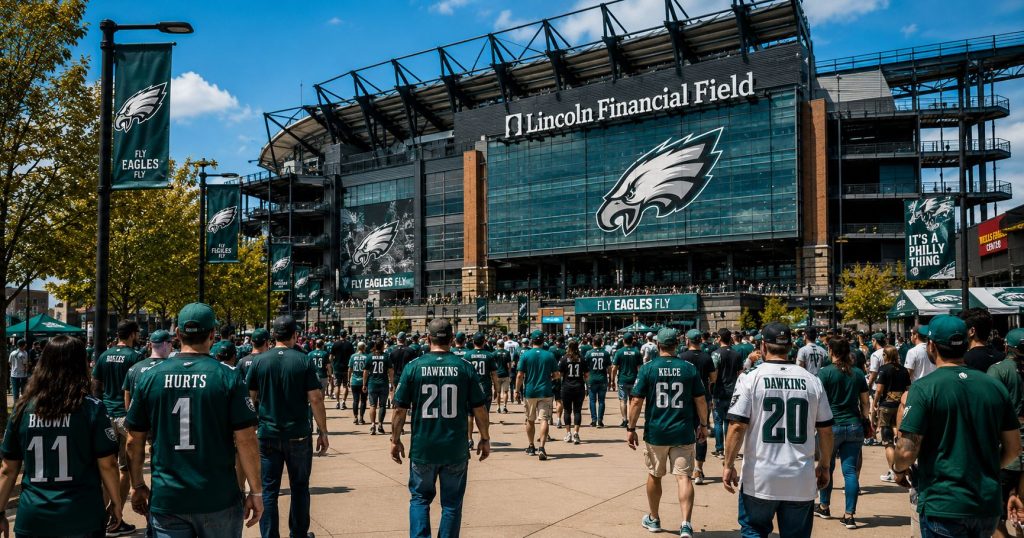
There’s a moment at Lincoln Financial Field that happens in every home game, usually sometime in the second quarter, when the crowd noise reaches a level where you genuinely can’t hear the person standing next to you in the concourse. Not because something happened on the field — sometimes it’s before the play even snaps. It’s just The Linc being The Linc, a stadium in South Philadelphia that was built in a neighborhood that was already loud and has been getting louder every year since it opened in 2003. I’ve been in louder stadiums for bigger moments. I’ve never been in a stadium where the baseline noise level — the ambient Eagles fan energy before anything has happened yet — hits that hard on a consistent basis. That’s the thing about Eagles Nation that outsiders usually miss: the intensity isn’t situational. It’s the default setting.
Where Eagles Fan Culture Actually Comes From
Philadelphia Eagles fandom didn’t develop in a vacuum. It grew out of a city with a specific relationship to its sports teams — one built on loyalty that doesn’t require reciprocation, high expectations that persist through losing seasons, and a willingness to hold the team and the city’s identity as the same thing even when that’s inconvenient. Philadelphia has four major professional sports teams, and they compete for the same fanbase in a city that takes all of them seriously. Eagles fandom is the loudest of the four, not because the team has been the most successful historically, but because football in Philadelphia hits a specific cultural nerve that baseball and basketball don’t quite reach in the same way.
The geography matters. Lincoln Financial Field sits in South Philadelphia, a neighborhood with deep working-class roots, Italian and Irish immigrant history, and a civic identity that has always been slightly adversarial toward outside perception. The Eagles fan reputation — passionate to the point of being nationally mischaracterized — comes directly from that neighborhood ethos. Eagles fans in the Pattison Avenue lots before a home game aren’t performing intensity for a camera. They’re being exactly what South Philadelphia has always been: loud, loyal, and uninterested in how that reads to people who don’t live there.
The NFC East context sharpens everything. Playing in a division with the Dallas Cowboys — a team marketed as “America’s Team” with a national fanbase built on decades of primetime television exposure — gives Eagles fans a specific rival identity that goes beyond normal football rivalry. The Cowboys are everything Eagles fans reject: corporate, brand-conscious, favored by national media. The Eagles, in the Philadelphia self-image, are the opposite. That division rivalry isn’t just a football thing. It’s a cultural argument about what kind of fan you are and what kind of city you come from.
The Fly Eagles Fly Tradition
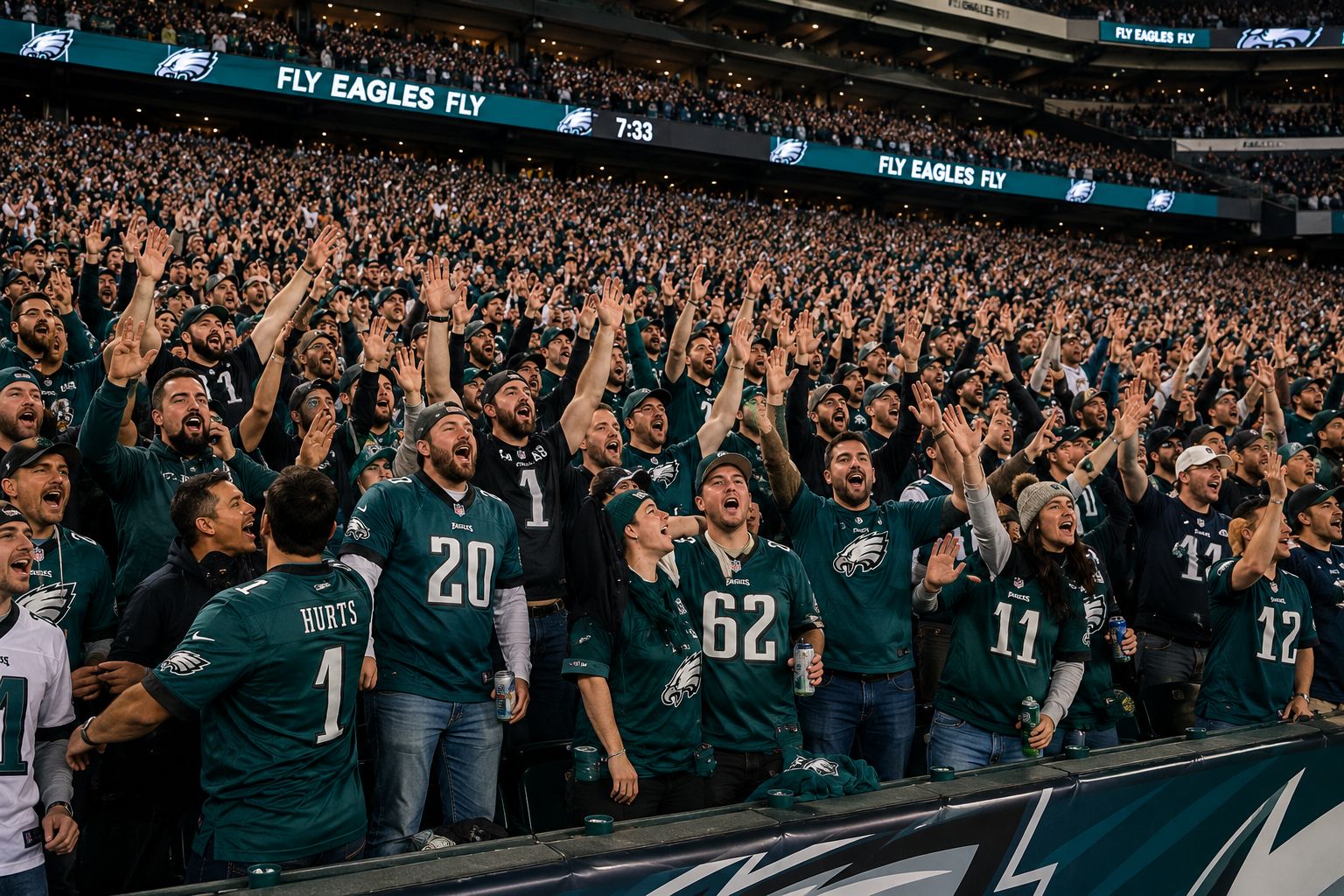
The “Fly Eagles Fly” fight song has been part of Eagles game day since 1948, which makes it one of the oldest fight songs still in regular use in professional football. What makes it distinct from most NFL team songs isn’t the melody or the lyrics — it’s how Eagles fans have integrated it into the game-day experience at Lincoln Financial Field in a way that feels organic rather than scripted.
Most NFL stadiums play their team’s fight song through the PA system at specific moments — touchdowns, the end of quarters, cued by the production team. At The Linc, Fly Eagles Fly breaks out from the stands independently, without PA prompting, at moments the crowd decides rather than moments the production team schedules. After a big defensive stop, after a fourth-down conversion, sometimes just when the energy in the stadium has been building long enough to need a release — the chant starts somewhere in the lower bowl and spreads. That organic quality is what makes it a genuine cultural artifact rather than a produced stadium moment. It’s something the fanbase does, not something the team asks them to do.
The call-and-response structure — “Fly, Eagles, fly / On the road to victory” — is simple enough that it works across 69,000 people without rehearsal. Eagles fans who have been going to games for thirty years and fans who are at their first game both know it. That shared knowledge is part of how Eagles identity gets transmitted across generations — the fight song is the same one your father knew, which is the same one his father knew, going back to a team that played at Connie Mack Stadium in North Philadelphia before The Linc, before Veterans Stadium, before Franklin Field.
Veterans Stadium and What It Built
You can’t fully understand Eagles fan culture without understanding Veterans Stadium, which stood in South Philadelphia from 1971 to 2003 and shaped the Eagles fan reputation that persists today. The Vet was a multipurpose concrete bowl shared with the Phillies, with artificial turf that was famously harsh on players, sightlines that weren’t optimized for either baseball or football, and a fan atmosphere that was routinely described by national media as the most hostile in professional sports.
The Vet had a courtroom in the basement. Not a metaphorical courtroom — an actual municipal courtroom, established in 1997 because the number of fan arrests at Eagles games had become significant enough that a judge needed to be on site to process them without clogging the city’s regular court system. That detail has been repeated so many times in Eagles fan mythology that it’s become a source of pride rather than embarrassment. Eagles fans who were at the Vet during those years wear the reputation as a badge — not because they endorse the behavior, but because it confirms the narrative about Philadelphia fandom being fundamentally different from the polished, branded fan experience at newer stadiums built for a different kind of audience.
Lincoln Financial Field replaced the Vet in 2003, and the transition was more than architectural. The Linc is a modern NFL facility with better sightlines, better amenities, and none of the courtroom infrastructure. But the fan culture that developed at the Vet transferred intact. The noise level, the intensity, the willingness to make visiting teams and their fans genuinely uncomfortable — all of it moved from one South Philadelphia address to another. The building changed. The fanbase didn’t.
The Players Who Built Eagles Identity
Eagles fan culture is inseparable from a specific set of players whose identities became intertwined with Philadelphia’s self-image in ways that went beyond football performance.
Brian Dawkins is probably the most complete example. The safety played for the Eagles from 1996 to 2008 and became the closest thing to a civic institution the franchise has produced — not because of his Hall of Fame statistics, though those would have been enough, but because of how he played. Dawkins was physically aggressive, emotionally transparent on the field, and visibly invested in winning in a way that Eagles fans recognized as their own values reflected back at them. When he was released by the Eagles in 2009 and signed with the Denver Broncos, the response in Philadelphia was something closer to grief than disappointment. His return to Lincoln Financial Field as a Bronco generated one of the longest standing ovations in the stadium’s history. He was inducted into the Eagles Hall of Fame before he was inducted into the Pro Football Hall of Fame, and in Philadelphia, that order of operations felt correct.
Donovan McNabb defined the Eagles through five NFC Championship appearances and a Super Bowl run in the 2000s, and his complicated relationship with the Philadelphia fanbase — booed on draft day in 1999, loved and criticized in equal measure through his career — captures something essential about how Eagles fans engage with their own players. Philadelphia fans don’t give unconditional support. They give conditional loyalty that has to be earned week by week, and that standard applies to franchise quarterbacks the same way it applies to backup defensive linemen. McNabb met that standard often enough to be genuinely beloved. The complexity of his relationship with the fanbase is more honest than most NFL franchise narratives, which tend to flatten careers into simple hero arcs.
Nick Foles and Super Bowl LII deserve their own category. The Eagles entered Super Bowl LII in February 2018 as underdogs against the New England Patriots, with their starting quarterback Carson Wentz on injured reserve and their backup — a journeyman quarterback who had briefly retired from football — starting the biggest game in franchise history. The Eagles won 41–33. Foles was named Super Bowl MVP. The parade down Broad Street drew an estimated 700,000 people, making it one of the largest gatherings in Philadelphia history. For Eagles fans, the Super Bowl LII win confirmed something they had always believed about themselves: that this fanbase could carry a team through adversity in a way that more comfortable, more celebrated fanbases couldn’t. And then in February 2025, with Jalen Hurts at quarterback, the Eagles won Super Bowl LIX over the Kansas City Chiefs — the same Chiefs team that had beaten them in Super Bowl LVII two years earlier. Back-to-back championship runs, a generation apart.
Eagles Fan Identity Outside Philadelphia
Eagles fandom extends well beyond the Philadelphia metropolitan area in ways that are worth understanding as a cultural phenomenon. There are large Eagles fan communities in South Jersey, Delaware, and southeastern Pennsylvania — the natural geographic catchment of a Philadelphia team. But Eagles fandom also has significant presence in cities that have no geographic connection to Philadelphia: large Eagles fan bars in New York, Los Angeles, Chicago, and in cities across the country where Philadelphia transplants have settled and maintained their team allegiance.
The Eagles fan identity travels with people because it’s not primarily about geography. It’s about a particular stance toward fandom — demanding, loyal without being unconditional, proud of the reputation even when the reputation is unflattering. An Eagles fan in a bar in Austin, Texas watching a road game surrounded by Cowboys fans isn’t just watching football. They’re representing a cultural position, one that defines itself partly in opposition to the Cowboys fan culture around them. That adversarial quality is part of what makes Eagles fandom portable across geography.
The midnight green color is part of how Eagles identity gets communicated outside Philadelphia. It’s a specific, identifiable shade that reads as Eagles immediately — not a generic dark green, not forest green, not teal, but the particular color that has been the Eagles’ primary since the Kelly green era ended in 1996. Eagles fans outside Philadelphia who wear midnight green fan gear are making a legible identity statement that other Eagles fans recognize instantly and that non-Eagles fans register as intentional rather than ambiguous. The Eagles Hawaiian shirt collection in midnight green all-over print works for exactly this reason — the color carries the identity signal clearly in any context, not just in a stadium.
The Kelly Green Question
No discussion of Eagles fan culture is complete without the Kelly green question, which has been a recurring debate in the Eagles fanbase for the better part of three decades. The Eagles wore Kelly green — a brighter, more saturated shade of green — from their early history through 1995, when they switched to the current midnight green. The midnight green era has now lasted longer than the Kelly green era, but Eagles fans who grew up watching the Wilbert Montgomery and Randall Cunningham teams in Kelly green have never fully let go of the argument that the old color was better.
The Eagles organization has brought Kelly green back periodically as alternate uniforms for specific games, and the response from the fanbase has been significant enough each time to confirm that this isn’t just nostalgia for its own sake. For a generation of Eagles fans, Kelly green is the color of a specific era of Eagles football — the Cunningham scrambles, the Buddy Ryan defense, the teams that were exciting and frustrating in equal measure — and the color carries that emotional freight in a way midnight green, which is associated with a different era and different players, doesn’t quite replicate. The debate is really a debate about which generation of Eagles football gets to define the team’s visual identity, and it hasn’t been resolved because both sides have legitimate claims.
What Eagles Fans Actually Wear
Eagles fan gear in Philadelphia follows a specific logic that’s worth understanding if you’re trying to dress appropriately for a game at The Linc rather than looking like you’re from out of town.
The jersey is the baseline. Jalen Hurts #1 is the current default, and you’ll see it in every variation — home midnight green, away white, alternate black — in the Pattison lots before any home game. The Eagles have enough franchise history that throwback jerseys are common: Cunningham #12, McNabb #5, Dawkins #20, Westbrook #36, Foles #9 from the Super Bowl LII run. Wearing a player’s throwback jersey at The Linc is a statement about which era of Eagles football you came up watching, and Eagles fans read those statements correctly.
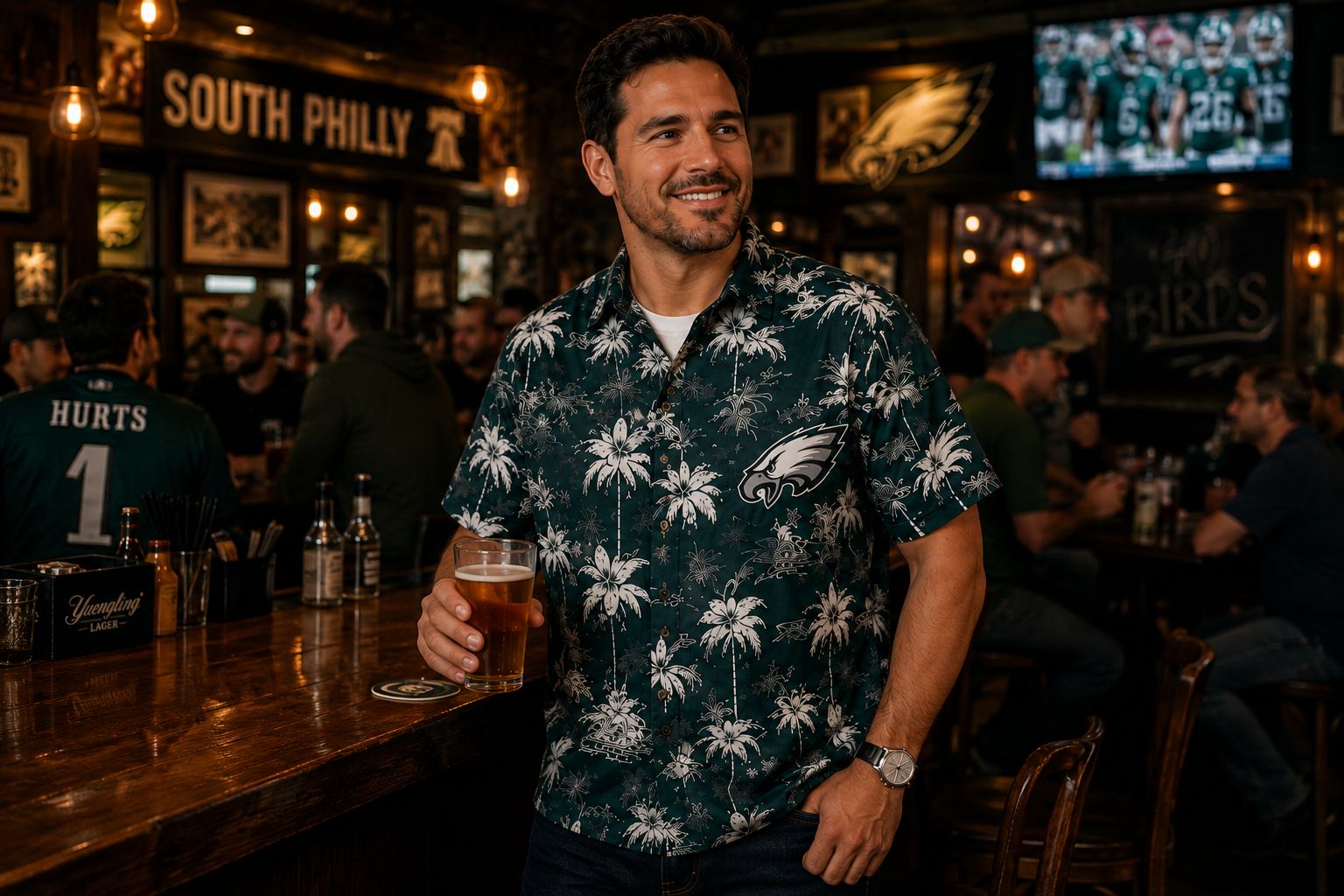
Beyond jerseys, Eagles fan gear has expanded significantly in the post-Super Bowl LII era as the fanbase grew and the national profile of the team increased. Midnight green apparel in non-jersey formats — hoodies, quarter-zips, hats, and increasingly, fan-designed pieces like the Eagles Hawaiian shirt in all-over midnight green print — has become a more visible part of how Eagles fans carry their identity outside the stadium context. The Hawaiian shirt format works specifically in Philadelphia’s year-round Eagles culture because it covers contexts the jersey doesn’t: South Philly bars during the week, Broad Street during the offseason, office environments where full game-day kit would be overdressed. For which Eagles Hawaiian shirt designs hold up best in those contexts, the Eagles Hawaiian shirt buying guide covers the collection honestly.
Eagles vs Cowboys: The Defining Rivalry
The Eagles-Cowboys rivalry is the defining relationship in Eagles fan culture in a way that the Giants or Redskins rivalries, however competitive on the field, haven’t quite matched. The Cowboys are the rival because they represent a specific cultural opposite: national media favoritism, a fanbase built partly on fair-weather affiliation, a franchise identity built on marketing rather than on the kind of gritty neighborhood loyalty that Eagles fans see as their own defining characteristic.
When the Eagles play the Cowboys at Lincoln Financial Field, the atmosphere is different from any other home game. It’s not just louder — it’s more focused. The crowd noise has a specific quality of directed intensity toward the opposing team and their fans that doesn’t have quite the same edge in games against the Giants or the Commanders. Eagles fans who travel to AT&T Stadium in Arlington for a road game against Dallas are doing something that requires genuine commitment: being visibly, loudly Eagles in a building full of Cowboys fans, in a city that treats the Cowboys as a civic institution. The Eagles fans who show up at Jerry World for road games are usually some of the most committed in the fanbase. They know what they’re walking into.
The Super Bowl LVII matchup between the Eagles and Chiefs in February 2023 — which the Chiefs won — set up the Super Bowl LIX rematch in February 2025, which the Eagles won. For Eagles fans, that sequence had a specific narrative satisfaction: losing one, coming back and winning the next one against the same team, confirming the belief that this fanbase eventually gets what it’s owed.
Frequently Asked Questions
Why are Philadelphia Eagles fans so passionate?
Eagles fan culture developed in South Philadelphia, a neighborhood with a specific working-class identity and a civic character that has always been defined by loyalty and high expectations rather than politeness. The Vet era — Veterans Stadium, which housed the Eagles from 1971 to 2003 — shaped an intensity that transferred intact to Lincoln Financial Field when it opened in 2003. Eagles fans don’t separate team performance from civic identity the way more casual fanbases do. The team’s success and failure feels personal in Philadelphia in a way that’s specific to how the city relates to its sports teams.
What does “Fly Eagles Fly” mean?
Fly Eagles Fly is the Philadelphia Eagles’ official fight song, written in 1948 and still sung by Eagles fans at Lincoln Financial Field at every home game. The full lyric is “Fly, Eagles, fly / On the road to victory.” What makes it distinctive isn’t the lyric itself but how Eagles fans use it — the chant breaks out organically from the crowd without PA prompting, at moments the fans decide rather than moments the stadium production team schedules. That organic quality is what makes it a genuine piece of Eagles fan culture rather than a produced stadium moment.
What is Eagles Nation?
Eagles Nation refers to the Philadelphia Eagles fanbase broadly — not just fans in the Philadelphia metropolitan area, but Eagles fans across the country and internationally who carry the team’s identity with them. Eagles fandom is particularly portable because it’s built on a specific cultural stance — demanding, loyal, adversarial toward rival fanbases — rather than primarily on geography. Eagles fan bars exist in most major American cities. The fanbase’s national presence grew significantly after Super Bowl LII in 2018 and again after Super Bowl LIX in 2025.
What color green do the Philadelphia Eagles wear?
The Philadelphia Eagles wear midnight green as their primary color — a deep, dark shade of green that Eagles fans will tell you is distinct from forest green, dark green, or teal. The team wore Kelly green, a brighter and more saturated shade, from their early history through 1995, and has periodically brought Kelly green back as an alternate uniform. The midnight green era began in 1996 and has now lasted nearly three decades. Both colors have passionate supporters in the fanbase, and the debate over which shade best represents the franchise is ongoing.
What happened at Veterans Stadium with the Eagles?
Veterans Stadium was the Eagles’ home from 1971 to 2003, shared with the Philadelphia Phillies. It developed a reputation as one of the most intense fan environments in professional sports, partly because of the passionate South Philadelphia fanbase and partly because the stadium’s design created an unusually loud atmosphere. In 1997, a municipal courtroom was established in the stadium’s basement to process fan arrests on-site without clogging Philadelphia’s regular court system — a detail that has become part of Eagles fan mythology. The stadium was demolished in 2004, replaced by Lincoln Financial Field, which opened in 2003.
Who are the most beloved players in Eagles history?
Brian Dawkins is widely considered the most beloved player in Eagles history — a safety who played for Philadelphia from 1996 to 2008 and whose intensity and loyalty became a mirror for Eagles fan values. Donovan McNabb, who led the team to five NFC Championship appearances in the 2000s, is beloved despite a complicated relationship with the fanbase throughout his career. Nick Foles earned permanent Eagles fan affection for his Super Bowl LII MVP performance in 2018. Randall Cunningham from the late 1980s and early 1990s, Wilbert Montgomery, Chuck Bednarik, and Brian Westbrook all hold significant places in Eagles franchise history.
Written by Patrick Cooper · NFLHawaiianShirt.com Fandom & Culture
See also: Best Gifts for Philadelphia Eagles Fans · What to Wear to a Philadelphia Eagles Game · Best Philadelphia Eagles Hawaiian Shirts Ranked · What to Wear to an NFL Game