fandom culture
Cowboys Nation: Fan Traditions, Culture & the America’s Team Identity
May
There is no neutral position on the Dallas Cowboys. You find this out fast. Wear the star somewhere outside Texas — in a Philadelphia airport, in a Boston bar, in a sports bar in Denver where the Broncos game is on — and someone will have something to say before you order. Not always hostile. Sometimes just a look. But always something. No other NFL fanbase generates that kind of ambient reaction just by showing up. That’s been true for nearly fifty years, and it didn’t happen by accident. This is what Dallas Cowboys fan culture actually is — where it came from, why it won’t stop growing, and why the rest of the NFL can’t stop paying attention.
How Dallas Cowboys Became “America’s Team”
NFL Films coined the phrase in 1978. Director Bob Ryan was editing the Cowboys’ season highlight reel and noticed something in the footage: wherever the Cowboys played away games, there were Cowboys fans in the stands. Not a section. Sections. In stadiums across the country, in cities that had their own teams, people showed up wearing navy and silver to watch Dallas play. Ryan wrote the narration around what the camera had been seeing all year. He called them “America’s Team” because that’s what the footage showed.
The Cowboys of that era were Tom Landry’s Cowboys. The fedora on the sideline. The stoic expression through four quarters regardless of score. Twenty-nine years, one head coach, one way of doing things. The Cowboys Cheerleaders, already a cultural phenomenon by the late 1970s, amplified the team’s visibility in ways that pure football coverage couldn’t. NFL Films, the cheerleaders, Landry on the sideline, Roger Staubach at quarterback — the Cowboys were a complete television package at a moment when the NFL was figuring out how to become a national entertainment product.
Jerry Jones bought the franchise in 1989, fired Landry on day one, and the Cowboys became something else. But the label had already stuck. You don’t un-become America’s Team once NFL Films has named you and a generation has grown up with it.
Why Half the NFL Hates Them for It
Walk into any sports bar outside Texas during a Cowboys game and you’ll find at least one person visibly rooting against them who doesn’t have a team in the game. The anti-Cowboys fan is a real category — distinct from fans of rival teams, distinct from people who simply prefer other franchises. These are people whose rooting interest, for three hours, is specifically that Dallas loses.
The grievance is real. The Cowboys get prime-time slots and front-page treatment in seasons where they exit in the wild card round. They’ve played on Thanksgiving every year since 1966 — more national airtime than any other franchise gets in a season, handed to them annually regardless of record. Other teams with better recent results get less coverage. That’s not a conspiracy, it’s market dynamics — the Cowboys move ratings — but it doesn’t feel fair to fans of franchises that have actually won things in the last thirty years and still can’t get a prime-time slot.
The other half of it is Cowboys fans themselves. The confidence. The expectation of winning that persists regardless of results. To fans of teams that have earned their optimism recently, a Cowboys fan’s unwavering belief in their team after three decades without a championship reads as entitlement. It is, in a way. But it’s also what makes Cowboys fans Cowboys fans.
The 90s Cowboys Dynasty and What It Did to the Fanbase
Three Super Bowls in four years. XXVII, XXVIII, XXX. Troy Aikman, Emmitt Smith, Michael Irvin. The Triplets. Jimmy Johnson building the roster through audacious trades — the Herschel Walker trade funded the entire dynasty — before Barry Switzer inherited it and won with it. Texas Stadium in Irving, the hole in the roof that Tex Schramm said was there so God could watch his favorite team.
Those teams created Cowboys fans who had no geographic connection to Dallas and never would. A ten-year-old in Sacramento in 1993 watched Aikman to Irvin on a Sunday afternoon, watched Emmitt run through the Bills in Super Bowl XXVIII, and became a Cowboys fan permanently. That’s not unusual in sports — kids attach to dominant teams. What was unusual was the scale. The Cowboys were on national television constantly, they were winning constantly, and the Cowboys Cheerleaders were a pop culture presence that kept the brand visible outside the sports pages. The recruitment happened at a volume most franchises never experience.
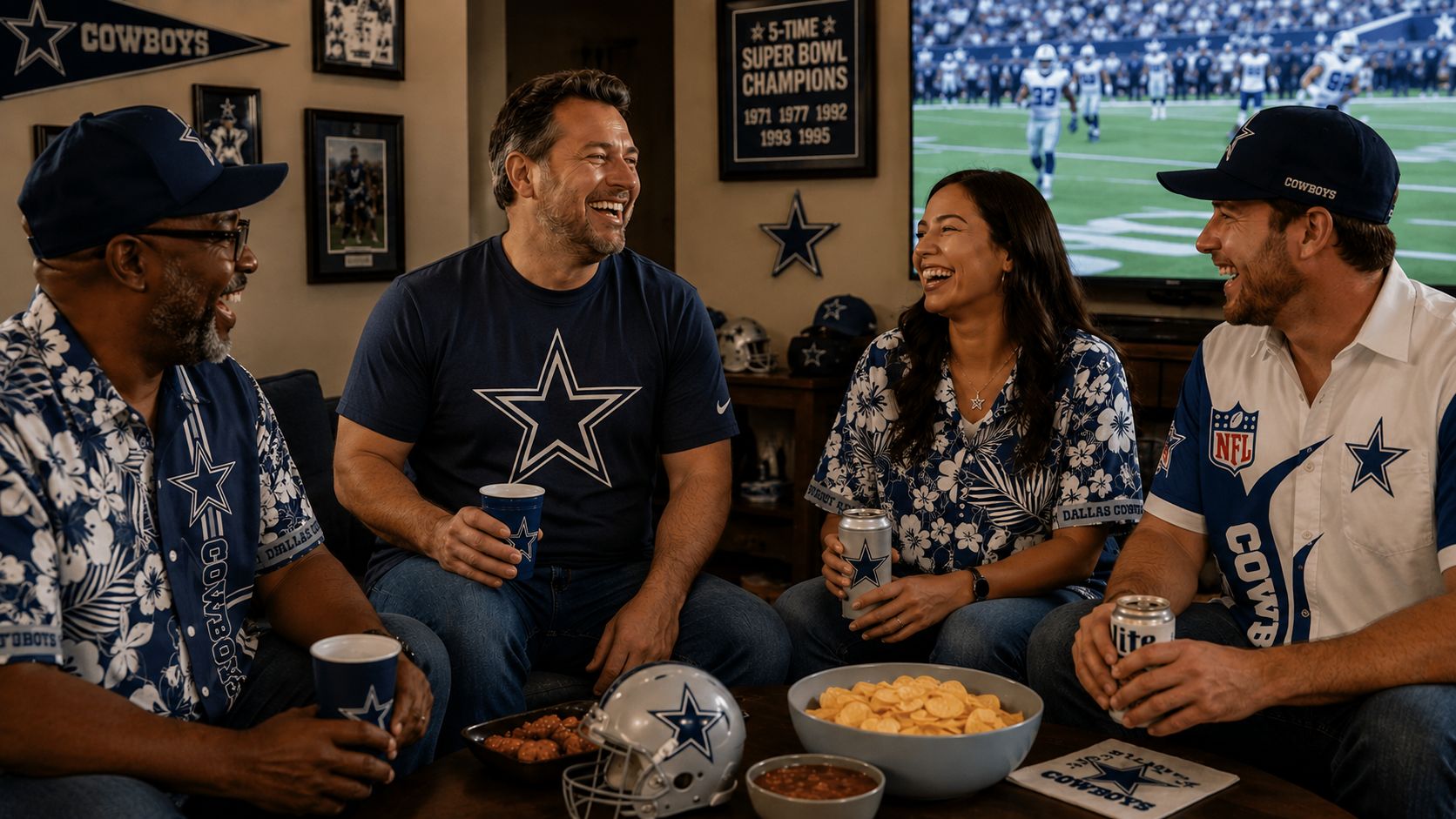
Those fans are now in their thirties and forties. They’re raising kids who are Cowboys fans. The dynasty compounded across generations in a way that a single championship run doesn’t produce — it takes three titles in four years, sustained excellence, and a media presence large enough to reach kids in markets with no NFL team of their own.
Why Dallas Cowboys Fans Exist in Every City
Go to any major airport in the country and you’ll see the star. Cowboys gear at LaGuardia. Cowboys hats at O’Hare. Cowboys jackets at Sea-Tac. It’s not random. There are specific reasons Cowboys fans ended up in places that have their own teams and stayed Cowboys fans anyway.
Military family fandom is one of them. Fort Worth and the broader DFW area are home to Naval Air Station Joint Reserve Base Fort Worth, one of the largest joint reserve bases in the country. Families posted through Texas during the Landry years or the 90s dynasty became Cowboys fans and then moved — to Virginia, to California, to Germany, to everywhere the military sends people. The Cowboys fandom traveled with them and got passed to their kids.
TV-era fandom built the rest of it. Before the NFL’s current broadcast distribution, families in markets without local teams watched whatever national games were available. The Cowboys were on more than anyone. A household in rural Mississippi in 1975 with no NFL team within driving distance watched the Cowboys every week and became Cowboys fans the same way you become fans of anything you spend enough time with.
And Mexico. The Cowboys and Raiders have the largest Mexican fanbases in the NFL — a product of broadcast reach into northern Mexico that goes back decades before the league made formal international expansion a priority. In Monterrey and Chihuahua and Tijuana, Cowboys games on Sunday have been a fixed point since before most current fans were born.
A Cowboys fan in Dallas is a local sports fan. A Cowboys fan in Boston wearing the star to a bar where everyone else is in Patriots gear is making a different kind of statement — and they know it when they walk in.
AT&T Stadium, Jerry Jones, and the Cowboys Identity
Jerry Jones bought the Cowboys for $140 million in 1989 and fired Tom Landry the day he took over. The move was widely condemned. Jones hired Jimmy Johnson, drafted Emmitt Smith, and won three Super Bowls in six years. Whatever else you think about Jerry Jones, the first decade of his ownership is hard to argue with.
AT&T Stadium opened in Arlington in 2009. $1.3 billion. Eighty thousand capacity. The largest video board in NFL history at the time of opening, hanging over the field like a second sky. Jerry Jones built it as a declaration — not just a stadium but a statement about what the Cowboys are supposed to be. Too much, critics said. Exactly right, Cowboys fans said. The debate about Jerry World mirrors the debate about Jerry Jones himself, which mirrors the debate about the Cowboys generally: enormous, loud, impossible to ignore, and producing results that haven’t matched the scale of the ambition since 1996.
Every Cowboys fan has a position on Jerry Jones. He’s too involved. He should hire a real GM. He’s a genius. He’s the reason they haven’t won anything. He’s the reason they’re worth ten billion dollars. The argument doesn’t resolve — it’s been running since 1989 and it’s part of what keeps the fanbase engaged in seasons when the product on the field doesn’t give them much else to talk about.
Dallas Cowboys Thanksgiving: The Tradition That Isn’t Optional
The Cowboys have played on Thanksgiving every year since 1966, with two exceptions. This is not an NFL tradition in the generic sense — the league added a second game in 2006 and a third in 2012. The Cowboys’ game is the original, and it has been there long enough that it’s structural now. It doesn’t require a reason. It’s just what Thanksgiving is.
For Cowboys fans, Thanksgiving is the highest-stakes casual viewing day of the year — the game most likely to be watched with family members who don’t follow football closely, in a living room or a backyard rather than a stadium or a sports bar. The social context is different from a regular game day. You’re not with your crew. You’re with your family, which means you’re probably the most visible Cowboys fan in the room, which means you’re representing. What fans wear to Thanksgiving gatherings — where a full game-day kit is slightly overdressed but plain clothes feel like a missed opportunity — is a real question that comes up every November. The Cowboys gift guide covers the Thanksgiving gifting window specifically — shipping deadlines, what works at a dinner table, and what to skip.
How Cowboys Fans Actually Dress
Navy and silver is one of the cleanest visual identities in professional sports. The star — simple, bold, no explanation required — has been one of the most reproduced sports marks in the world for fifty years. Cowboys fanwear skews toward the cleaner end of NFL fan aesthetics. Less face paint and foam hats than some fanbases. More navy and silver in formats that work outside a stadium.
There’s a natural crossover between Cowboys colors and a certain kind of American style that doesn’t exist for most franchises. Denim and boots and navy. The star on the back window of a pickup truck in rural Texas. Old Emmitt Smith jerseys worn to cookouts by dads who still believe in this team. Cowboys jackets at airports in cities where you’d expect nothing but local gear.
Cowboys fans outside Texas wear their colors more deliberately than local fans do — because it means something different to be the one person in a Boston bar wearing navy and silver. You dressed that way on purpose, and everyone in the room knows it. The AT&T Stadium outfit guide covers what that actually looks like from the Lot E tailgate through the post-game Arlington bar strip. For the specific designs worth buying in the Cowboys collection, the Cowboys Hawaiian shirt buying guide ranks all four categories.
The Contradiction at the Center of Cowboys Nation
The Cowboys have not won a Super Bowl since January 1996. One playoff win in the last twenty years. By any normal measure of franchise performance, this is a long drought.
Cowboys Nation has not shrunk. Every offseason, a significant portion of the fanbase genuinely believes this is the year. Not out loud, necessarily — Cowboys fans have been burned enough to have developed some public restraint — but internally, in the way that real fans actually feel about their team going into a new season, the expectation is there. It comes back every August.
Part of it is the dynasty operating as a reference point. Fans who watched those 90s teams don’t experience the drought as evidence of permanent mediocrity. They watched this franchise win three championships in four years. They know what it looks like when it works. The expectation of return isn’t irrational if you’ve seen it happen.
Part of it is Jerry Jones’s perpetual optimism machine — the offseason declarations, the big contracts, the stated belief every March that this roster is built to compete. But mostly it’s just what Cowboys fans are. The fandom survived the drought, grew through it, and shows no sign of recalibrating its expectations to match results. That stubbornness, that refusal to lower the ceiling regardless of recent floors, is as definitional to Cowboys Nation as the star on the helmet.
The rest of the NFL finds this infuriating. Cowboys fans find it entirely reasonable. That gap in perspective has been the defining dynamic of the last three decades, and it will probably be the defining dynamic for the next three as well. For fans who’ve been carrying that expectation since the dynasty years, the NFL Hawaiian shirt guide covers the gear that matches the identity — fan apparel that works outside the stadium the way Cowboys Nation operates outside the season.
Frequently Asked Questions
Why do people hate Dallas Cowboys fans?
Two reasons. The Cowboys get prime-time slots, Thanksgiving games, and front-page treatment regardless of their postseason record — fans of franchises that have actually won things recently and gotten less coverage have a real grievance. And then there’s Cowboys fans themselves: the confidence, the annual expectation of winning, the refusal to recalibrate after thirty years without a championship. From the outside it reads as entitlement. From the inside it reads as loyalty. Neither side is entirely wrong.
Why are there Dallas Cowboys fans everywhere, not just in Texas?
Three overlapping reasons that compounded over fifty years. The 90s dynasty — three Super Bowls in four years on national television — created fans across the country the way any dominant team does, at a scale most franchises never reach. Military family fandom carried Cowboys allegiance out of Texas as families posted through DFW rotated to other locations. And TV-era exposure gave the Cowboys a national audience in markets without local NFL teams long before the league formalized international expansion. Thirty years of inherited fandom on top of all three produces what you see now.
Why do the Dallas Cowboys always play on Thanksgiving?
The Cowboys have held the Thanksgiving slot since 1966 — the original NFL Thanksgiving game, predating the league’s expansion of the holiday schedule by forty years. It’s been there long enough that it’s simply structural now: the Cowboys play on Thanksgiving because that’s what Thanksgiving is. For Cowboys fans it’s the highest-visibility casual viewing day of the year — the game most likely to be watched with family, in a home setting, with people who don’t normally follow football at all.
What is the history of the Dallas Cowboys Thanksgiving game?
The Cowboys have played on Thanksgiving every year since 1966, with just two exceptions in 1975 and 1977. The tradition began when the NFL gave Dallas the annual Thanksgiving slot before it became a multi-game holiday. After nearly sixty years, it’s the longest-running Thanksgiving game in NFL history. For Cowboys fans, it functions as a second home game — the one game each year guaranteed to be watched by the widest possible audience, including family members who don’t normally follow football.
Who are the Dallas Cowboys’ biggest rivals?
The Cowboys’ most intense rivalries are within the NFC East — the Philadelphia Eagles, New York Giants, and Washington Commanders. The Eagles rivalry is the most heated, particularly since Philadelphia’s Super Bowl LIX win over Kansas City in February 2025 intensified the dynamic. Historically, the San Francisco 49ers rivalry from the 90s dynasty era — multiple NFC Championship Game matchups between two of the league’s most dominant franchises — remains significant for fans who followed those teams.
Shop Dallas Cowboys Hawaiian shirts →
Written by Patrick Cooper · NFLHawaiianShirt.com Fandom & Culture
See also: Dallas Cowboys Gifts Under $50 · What to Wear to an NFL Game · Dallas Cowboys Seasonal Gifts